Itroduction
The Dematerialization of Finance
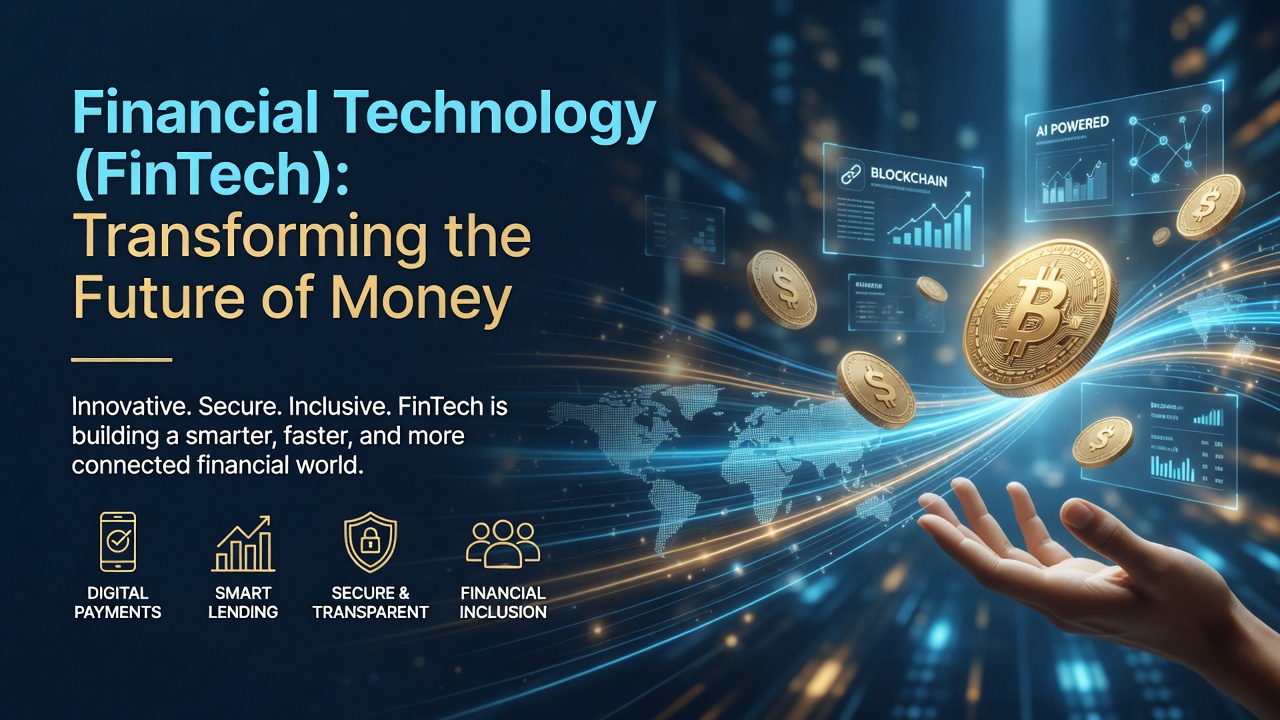
For most of human history, money was tangible—gold coins, paper notes, ledger books. In the last two decades, that reality has fundamentally shifted. We have entered the era of Financial Technology, or “FinTech.” FinTech is not simply about banking apps or credit card readers; it is the comprehensive restructuring of how value is created, stored, moved, and invested in a global, digital-first economy.
FinTech bridges the gap between traditional legacy financial institutions—often weighed down by bureaucratic complexity and outdated infrastructure—and the rapid, frictionless expectations of a digital society. By leveraging big data, artificial intelligence, blockchain, and cloud computing, FinTech enables services that were previously the exclusive domain of institutional giants to be accessed instantly by anyone with a smartphone.
This guide deconstructs the FinTech ecosystem, tracing its evolution from early digital payment processing to decentralized finance. We will examine the critical industry verticals, the technological pillars that make it all possible, the complex web of regulatory compliance, and the future trajectory of money as it transitions into a digital-native asset class.
2. Industry Verticals: The Pillars of Modern FinTech
The FinTech landscape is vast, but it is best understood by breaking it down into distinct functional verticals that address specific inefficiencies in traditional banking.
2.1. Payments and Digital Wallets
This is the most visible segment of FinTech. It involves the digitalization of the transaction process, moving away from physical cash and plastic cards. It includes everything from Peer-to-Peer (P2P) transfers (like Venmo or PayPal) to Point-of-Sale (POS) systems and digital wallets (Apple Pay, Google Pay). These systems have turned local currencies into global digital tokens, enabling instantaneous cross-border value transfer at a fraction of the cost of traditional wire transfers.
2.2. Neobanking (Digital-Only Banking)
Neobanks, or “Challenger Banks,” operate entirely online with no physical branch networks. By shedding the immense overhead of physical real estate and legacy workforce costs, they offer superior user interfaces, zero-fee structures, and high-yield savings accounts that traditional banks struggle to match. They represent the “unbundling” of the bank, where users often use a Neobank for daily spending while using a traditional institution only for long-term loans.
2.3. Lending and Credit
FinTech has revolutionized the lending process by replacing the traditional “loan officer” with algorithmic risk assessment. FinTech lending platforms utilize Alternative Data—such as mobile phone usage patterns, utility payment history, and even e-commerce activity—to assess creditworthiness. This democratizes access to capital, providing loans to the “unbanked” or “thin-file” individuals who would otherwise be rejected by traditional credit bureaus.
2.4. InsurTech
The insurance sector is arguably the slowest to innovate, yet FinTech is forcing a shift. InsurTech uses IoT (Internet of Things) devices to price risk dynamically. For example, auto insurance premiums can now be adjusted in real-time based on actual driving behavior (telematics) rather than static demographic data. This creates a fairer, usage-based model where safe drivers pay less.
2.5. Investing and Wealth Management (Robo-Advisors)
Automated investment platforms, or Robo-Advisors, have democratized portfolio management. These platforms use algorithmic models to optimize asset allocation based on a user’s risk tolerance, age, and financial goals. By replacing human financial advisors with software, they have slashed management fees from 1-2% annually to near-zero, making long-term index investing accessible to the average retail investor.
3. The Technological Stack
FinTech is powered by a convergence of high-velocity technological trends. Understanding the “under-the-hood” stack is essential to understanding why FinTech is so much more efficient than legacy banking.
| Technology | Application in FinTech |
|---|---|
| Artificial Intelligence (AI) | Automated fraud detection, credit scoring, algorithmic trading, and hyper-personalized customer support via LLMs. |
| Blockchain / DLT | Immutable transaction records, smart contracts, decentralized settlements, and the foundation for digital assets. |
| Cloud Computing | Allows FinTech startups to scale infrastructure instantly based on traffic demand, reducing the need for costly physical server rooms. |
| Big Data Analytics | Analyzing massive datasets to identify market trends, customer behavior, and hidden financial risks in real-time. |
4. The Regulatory Frontier (RegTech)
FinTech operates in the most heavily regulated environment on earth. As the industry moves faster than legislative bodies, a new sub-sector has emerged: RegTech (Regulatory Technology). RegTech involves using software to automate compliance tasks—the most tedious and expensive part of traditional banking.
Key Compliance Pillars:
- KYC (Know Your Customer): FinTechs must verify the identity of every user. RegTech automates this using biometric verification (facial recognition), document scanning, and database cross-referencing, ensuring a user is who they claim to be in seconds rather than days.
- AML (Anti-Money Laundering): FinTech platforms use machine learning to flag suspicious transaction patterns. If a transaction deviates from a user’s historical behavior or matches patterns indicative of money laundering, the software flags it for manual review automatically.
- Data Privacy (GDPR/CCPA): Protecting sensitive financial data is the baseline. FinTechs must employ state-of-the-art encryption, zero-knowledge proofs (proving identity without revealing the actual data), and strict data residency compliance.
5. The Future: Decentralization and Open Finance
The industry is currently moving toward “Open Finance”—a system where financial institutions are required to share their data (with user consent) via APIs with third-party FinTech providers. This shifts power from the bank to the consumer.
5.1. Decentralized Finance (DeFi)
DeFi is the most radical evolution in the industry. It proposes the removal of all intermediaries (banks, exchanges, clearinghouses) and replaces them with Smart Contracts—self-executing code stored on a blockchain. In DeFi, you can lend, borrow, and trade assets without ever needing to trust a counterparty; you only need to trust the code.
5.2. Central Bank Digital Currencies (CBDCs)
Governments are catching up to the crypto movement. CBDCs are digital versions of a country’s fiat currency, issued and backed by the central bank. They aim to combine the efficiency of digital payments with the stability of a government-backed currency, potentially rendering the traditional retail banking rails obsolete for domestic transfers.
Frequently Asked Questions (FAQ)