Introduction
The Dawn of a Hyper-Connected World
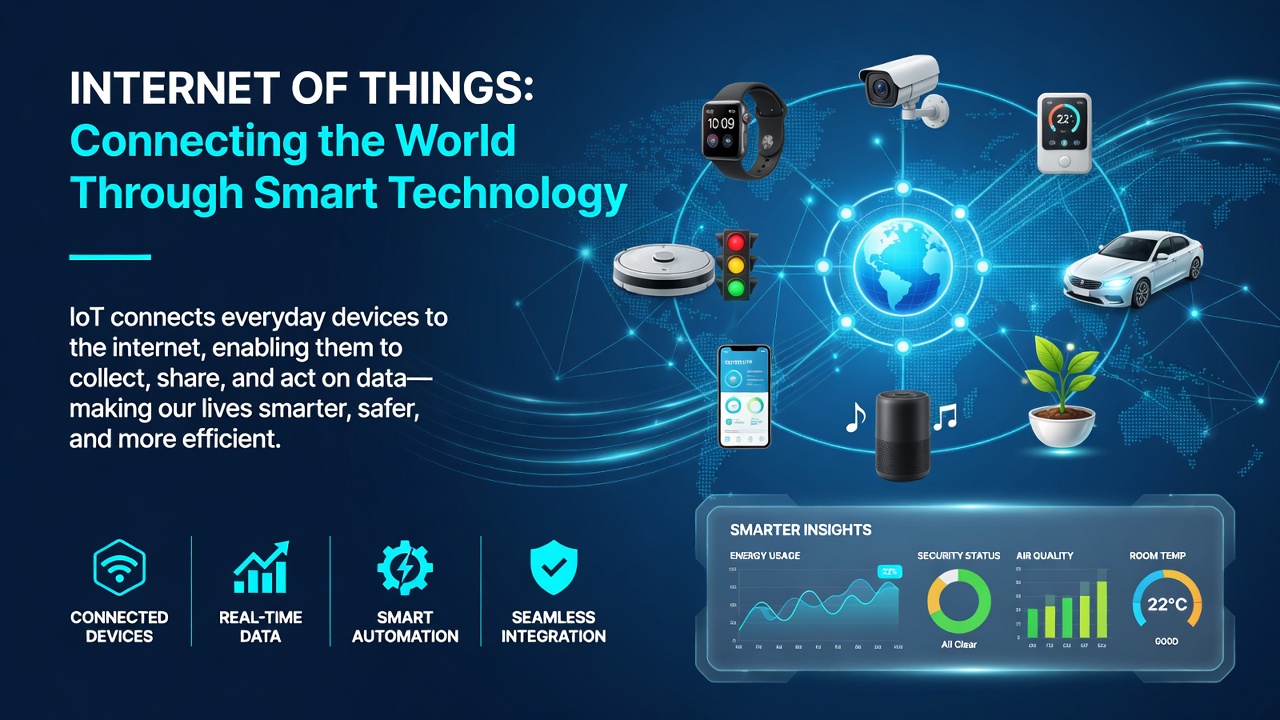
For the first few decades of its existence, the internet was primarily a network of computers—desktops, laptops, and eventually smartphones—used by humans to communicate, share information, and conduct commerce. It was the “Internet of People.” However, we have now definitively crossed the threshold into a new era: the Internet of Things (IoT).
The Internet of Things refers to the billions of physical devices around the world that are now connected to the internet, all collecting, sharing, and acting upon data. Thanks to the arrival of super-cheap computer chips, ubiquitous wireless networks, and massive advancements in cloud computing, it is now possible to turn anything—from a pill to an airplane—into a part of the IoT. By connecting up all these different objects and adding sensors to them, we add a level of digital intelligence to devices that would be otherwise dumb, enabling them to communicate real-time data without involving a human being.
This comprehensive guide explores the profound implications of IoT. It unpacks the intricate architecture that makes these systems work, examines the transformative applications across various industries, addresses the critical security and privacy challenges that threaten this connected ecosystem, and looks toward the future where IoT converges with Artificial Intelligence (AI) and 5G to create a truly smart planet.
2. The Core Architecture of IoT: How It Actually Works
An IoT system is not a single technology; rather, it is an ecosystem of integrated technologies that work in concert. A complete IoT system requires hardware, communication infrastructure, software, and a user interface. This architecture can generally be broken down into four distinct layers.
Layer 1: The Perception Layer (Sensors and Actuators)
This is the physical layer of the IoT system. It consists of the actual “things”—the devices deployed in the physical world.
- Sensors: These are devices that detect changes in the physical environment and convert them into electrical signals (data). Examples include temperature sensors, proximity sensors, optical sensors (cameras), humidity sensors, accelerometers, and gyroscopes. They are the “eyes and ears” of the IoT system.
- Actuators: While sensors collect data, actuators act upon it. An actuator receives a signal from the system and converts it into a physical action. Examples include a smart thermostat turning on the HVAC system, a valve opening in a smart irrigation system, or a robotic arm moving on a factory floor.
Layer 2: The Network/Transport Layer (Connectivity)
Once data is collected by the sensors, it needs a medium to travel to a central processing system. This is the network layer, which involves various communication protocols and gateways.
Because IoT devices vary wildly in their power capacity, bandwidth requirements, and physical location, no single network standard fits all. The choice of connectivity depends entirely on the use case:
- Short-Range/Low-Power: Bluetooth Low Energy (BLE), Zigbee, and Z-Wave are ideal for smart homes where devices are close together and need to conserve battery life.
- Medium-Range: Wi-Fi provides high bandwidth for devices like smart TVs and security cameras but consumes significant power.
- Long-Range/Low-Power (LPWAN): Technologies like LoRaWAN and Sigfox are designed for devices that need to transmit small amounts of data over vast distances (e.g., agricultural sensors across a massive farm) while running on a single battery for years.
- Cellular (4G/5G/NB-IoT): Used for mobile IoT applications like fleet tracking or connected cars, where ubiquitous coverage and high reliability are required.
Often, devices communicate first with an IoT Gateway—a localized hub that aggregates data from multiple sensors, translates protocols, and provides a first line of security before sending the data to the cloud.
Layer 3: The Data Processing Layer (Cloud and Edge Computing)
This is where the raw data is transformed into actionable intelligence. When the data reaches the cloud (e.g., AWS IoT, Microsoft Azure IoT, Google Cloud IoT), software processes it. This can be as simple as checking if a temperature reading falls within an acceptable range, or as complex as using machine learning algorithms to predict when a jet engine might fail.
Layer 4: The Application Layer (User Interface)
The final layer is where the processed data is presented to the end-user, usually via an app or web dashboard. This allows the user to monitor the system in real-time, view historical analytics, and send commands back down the chain to the actuators. For example, a user looking at a smart home app on their phone, seeing the temperature, and tapping a button to turn on the AC.
3. Transformative Applications: IoT Across Industries
The true power of IoT lies not in the technology itself, but in its application across virtually every sector of the global economy. By bridging the physical and digital worlds, IoT is driving unprecedented efficiency, safety, and innovation.
3.1. Smart Homes and Consumer IoT
This is the most visible manifestation of IoT for the average person. The smart home ecosystem aims to automate daily tasks, improve security, and optimize energy consumption.
- Energy Management: Smart thermostats (like Nest or ecobee) learn user behavior and adjust heating/cooling automatically, drastically reducing energy waste. Smart plugs and connected lighting systems allow for remote monitoring and scheduling.
- Home Security: Connected doorbells (like Ring), smart locks, and IP cameras provide real-time monitoring and alert homeowners to unusual activity via their smartphones, regardless of where they are in the world.
- Voice Assistants: Devices like Amazon Echo (Alexa) and Google Home act as the central command hubs, allowing users to control their entire IoT ecosystem using natural language processing.
3.2. Industrial Internet of Things (IIoT) and Industry 4.0
While consumer IoT gets the headlines, the Industrial Internet of Things (IIoT) is where the massive economic impact is occurring. It is the driving force behind “Industry 4.0″—the fourth industrial revolution.
- Predictive Maintenance: Historically, machines were repaired either on a fixed schedule (which is inefficient) or after they broke down (which causes catastrophic downtime). IIoT sensors monitor the vibration, temperature, and acoustics of machinery in real-time. AI algorithms analyze this data to predict exactly when a component will fail, allowing for targeted maintenance before a breakdown occurs.
- Supply Chain Optimization: IoT enables end-to-end visibility in supply chains. Asset tracking tags (using RFID or GPS) allow companies to monitor the exact location, temperature, and humidity of goods in transit. This is critical for “cold chain” logistics, ensuring vaccines or perishable foods are not spoiled during shipping.
- Digital Twins: IIoT enables the creation of a “Digital Twin”—a real-time, virtual replica of a physical asset, process, or even an entire factory. Engineers can run simulations on the digital twin to optimize performance without disrupting the physical operations.
3.3. Smart Cities
As the global population rapidly urbanizes, cities face immense pressure on infrastructure, resources, and services. IoT offers solutions to manage this complexity efficiently.
- Intelligent Traffic Management: IoT sensors at intersections monitor traffic flow in real-time. Instead of static timers, traffic lights dynamically adjust their phrasing based on actual congestion, significantly reducing gridlock and idling emissions.
- Smart Waste Management: Trash receptacles equipped with fill-level sensors notify municipal services only when they are full, optimizing garbage truck routes and reducing operational costs.
- Smart Street Lighting: Connected streetlights automatically dim when no pedestrians or vehicles are present, saving massive amounts of electricity. They can also double as environmental sensors, monitoring air quality and noise pollution.
3.4. Healthcare and the Internet of Medical Things (IoMT)
IoT in healthcare, often termed IoMT, is revolutionizing patient care, shifting it from a reactive model to a proactive, continuous monitoring model.
- Remote Patient Monitoring (RPM): Wearable devices and smart implants continuously monitor vital signs—heart rate, blood pressure, glucose levels, and oxygen saturation. This data is transmitted to healthcare providers in real-time, allowing them to detect anomalies and intervene before a patient requires hospitalization.
- Smart Hospitals: IoT is used to track the location of critical medical equipment (like defibrillators or wheelchairs) within massive hospital complexes, ensuring they are available instantly when needed. It also monitors environmental conditions in operating rooms and pharmaceutical storage areas.
- Ingestible Sensors: “Smart pills” contain microscopic sensors that transmit data once swallowed. They can monitor internal conditions or confirm that a patient has adhered to their medication schedule, sending a signal to a wearable patch which then updates a smartphone app.
3.5. Smart Agriculture (AgriTech)
To feed a growing global population while dealing with the impacts of climate change, agriculture must become vastly more efficient. IoT provides the data to make “precision farming” a reality.
- Soil and Climate Monitoring: Sensors distributed across fields monitor soil moisture, nutrient levels, temperature, and localized weather conditions. Farmers receive exact data on which specific areas of a field need watering or fertilizer, rather than applying them uniformly, conserving massive amounts of water and chemicals.
- Livestock Tracking: Wearable collars on cattle monitor their health, location, and grazing patterns. Similar to human fitness trackers, these devices can detect early signs of illness, allowing farmers to isolate and treat sick animals before disease spreads through the herd.
- Autonomous Machinery: IoT-connected drones and autonomous tractors survey crops, plant seeds, and apply pesticides with pinpoint accuracy, guided by GPS and sensor data.
4. The Dark Side of Connectivity: Security and Privacy Challenges
The proliferation of billions of connected devices has vastly expanded the global “attack surface” for malicious actors. The security challenges in the IoT ecosystem are immense, complex, and often systemic.
4.1. The Vulnerability of “Dumb” Smart Devices
Unlike laptops or smartphones, which have robust operating systems and regular security updates, many IoT devices—especially cheap consumer electronics like smart lightbulbs, IP cameras, and connected toys—are manufactured with minimal processing power and memory. This lack of resources means they cannot run traditional antivirus software or complex encryption algorithms. Furthermore, manufacturers, rushing to market, often neglect basic security principles.
4.2. Patching and Lifecycle Management
A critical flaw in the IoT ecosystem is the lack of update mechanisms. When a vulnerability is discovered in a traditional software program, a patch is issued. However, many IoT devices lack the capability to receive over-the-air (OTA) updates. Even if they do, manufacturers often abandon support for older devices after a few years, leaving them permanently vulnerable. This creates a massive, enduring legacy of unpatched devices connected to global networks.
4.3. Data Privacy and the Surveillance State
IoT devices are relentless data vacuums. A smart home knows when you wake up, when you leave for work, what you watch on TV, and what you say in the privacy of your living room. A smart car tracks everywhere you go and how fast you drive. This unprecedented collection of granular personal data raises profound privacy concerns.
- Data Monetization: Many IoT companies subsidize the cost of their hardware by selling the collected user data to third-party advertisers or data brokers. The terms of service are often opaque, leaving users unaware of how their intimate behaviors are being monetized.
- Corporate and Government Surveillance: If IoT data is not properly encrypted and anonymized, it can be intercepted. Furthermore, there are significant concerns regarding law enforcement or government agencies accessing data from smart home assistants, connected cars, or municipal smart city cameras, leading to an Orwellian level of mass surveillance.
4.4. Physical Safety Implications
When a traditional computer is hacked, the consequences are usually digital—data loss or financial theft. When an IoT device is hacked, the consequences can be kinetic and physically dangerous. Hackers have demonstrated the ability to remotely take control of connected cars (disabling brakes or steering), manipulate the dosage of connected medical infusion pumps, and theoretically sabotage industrial control systems (like power grids or water treatment plants). In the IoT era, cybersecurity is a matter of physical safety.
5. The Future Trajectory: AIoT and 5G
The Internet of Things is currently undergoing a massive evolutionary leap, driven by the convergence of two parallel technologies: Artificial Intelligence and 5G networks.
5.1. The Artificial Intelligence of Things (AIoT)
Currently, many IoT systems are relatively simple “if this, then that” mechanisms. The integration of Artificial Intelligence transforms them into autonomous, learning systems. This convergence is known as AIoT.
Instead of just sending raw data to a cloud dashboard for a human to review, AIoT devices can analyze data locally, recognize complex patterns, and make independent decisions. For example, a standard IoT security camera alerts you when it detects motion. An AIoT camera uses computer vision to determine if that motion is a stray dog, a passing car, or an actual intruder, only sending an alert for the latter. In industrial settings, AIoT enables massive fleets of robots to collaborate dynamically, learning from each other’s mistakes and optimizing manufacturing lines in real-time without human programming.
5.2. The 5G Catalyst
The rollout of 5G cellular networks is the critical catalyst that will allow IoT to reach its full potential. 5G is not just “faster 4G”; it is a fundamental architectural shift designed specifically with IoT in mind.
- Massive Device Density: 4G networks can support roughly 100,000 devices per square kilometer. 5G is designed to support up to 1 million devices per square kilometer. This is essential for dense Smart City deployments where every streetlight, vehicle, parking meter, and sensor requires a connection.
- Ultra-Reliable Low-Latency Communication (URLLC): 5G reduces network latency to near zero (under 1 millisecond). This allows for mission-critical IoT applications that require instant response times, such as remote robotic surgery (where a surgeon in New York operates on a patient in London) or autonomous vehicle coordination (where cars must communicate with each other instantly to avoid collisions at highway speeds).
6. Conclusion
The Internet of Things represents the ultimate digitization of the physical world. It is a technological paradigm shift that promises to optimize almost every aspect of human endeavor, from how we manage our homes and heal our bodies to how we grow our food and run our global supply chains. The potential benefits regarding efficiency, sustainability, and quality of life are monumental.
However, this hyper-connected future is not without profound risks. The rush to connect everything must be tempered with a rigorous, uncompromising commitment to cybersecurity and data privacy. If we fail to secure the IoT ecosystem, we risk building a global infrastructure built on a foundation of sand—vulnerable to systemic disruption and massive privacy violations. The challenge of the next decade is not merely connecting the remaining billions of “things,” but ensuring that those connections are secure, ethical, and ultimately serve to enhance the human experience.
Frequently Asked Questions (FAQ)