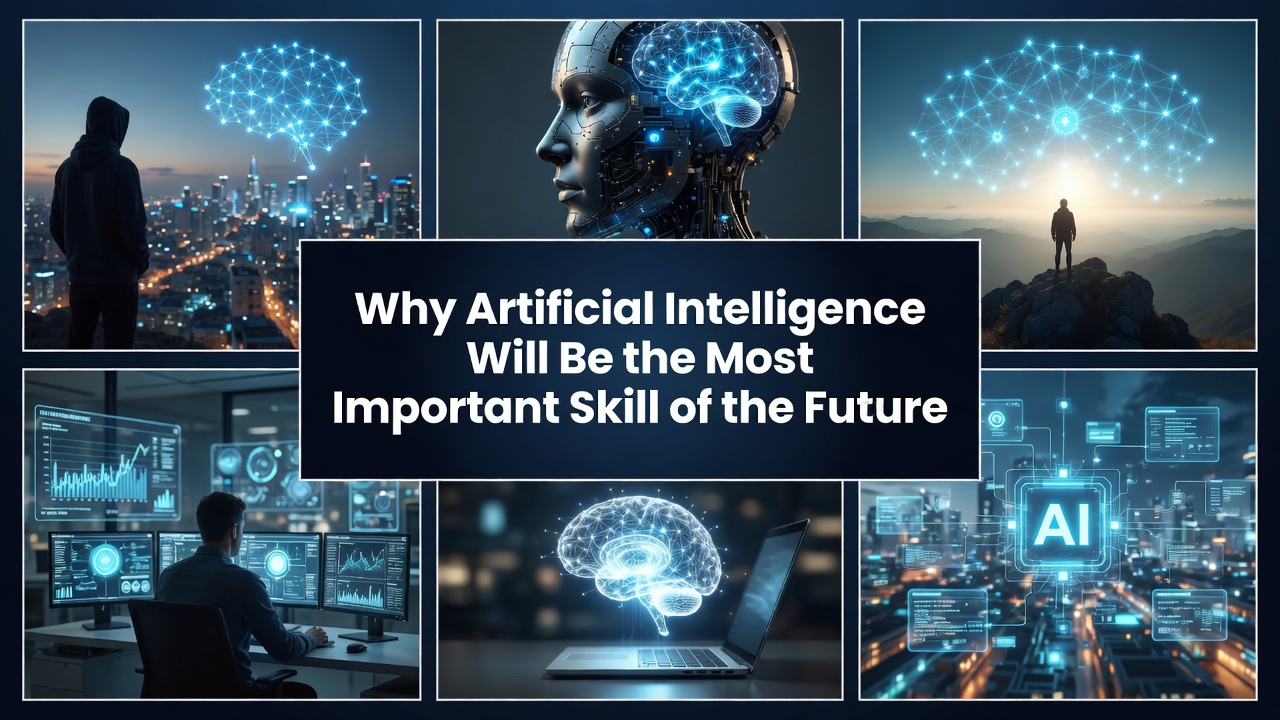
The AI Imperative
1. The Paradigm Shift in Human Labor
Throughout history, major technological revolutions—from the printing press to the steam engine to the internet—have fundamentally altered how humanity operates. However, Artificial Intelligence represents a paradigm shift unlike any before it. While previous innovations mechanized physical labor or accelerated communication, AI is the first technology to actively augment human cognition.
In the coming decade, AI will not be an isolated field reserved for data scientists and software engineers. It will become a foundational literacy, as essential to professional and creative survival as reading, writing, and basic computer skills are today. The future belongs not to those who can compete with machines, but to those who know how to collaborate with them seamlessly.
2. The New Digital Architecture
We are moving rapidly into an era where digital real estate and content creation are entirely powered by algorithmic intelligence. For digital creators and developers, the ability to integrate AI is the ultimate competitive advantage.
Accelerated Web Development & SEO
In the realm of digital publishing and web development, AI drastically reduces the friction between an idea and a live, monetized product. Developers can now utilize AI to rapidly generate HTML/CSS frameworks, structure massive databases, and scale projects. More importantly, AI excels at programmatic SEO. Creators building massive informational hubs—such as comprehensive biographies, academic profiles, or sports databases—can use AI to ensure content is highly optimized for search engines, scaling traffic efficiently for advertising revenue platforms like AdSense.
Bypassing Hardware Limitations
Historically, high-level coding, rendering, and web development required expensive, high-end desktop computers. AI is democratizing this process. Cloud-based AI assistants remove traditional hardware barriers, allowing creators to write, debug, and deploy complex code, or generate heavy media assets, entirely from mobile devices. This mobility and accessibility mean that anyone with an internet connection now commands the processing power of a full production studio.
3. Prompt Engineering: The Language of the Future
If AI is the engine of the future, Prompt Engineering is the steering wheel. The ability to effectively communicate with AI models—instructing them to produce precise, high-fidelity outputs—is rapidly becoming the most lucrative technical skill on the market.
This skill is particularly critical in digital media. Creators are actively using advanced prompt engineering to generate flawless digital assets, ranging from ultra-realistic imagery to highly specific 4K vertical videos formatted perfectly for mobile platforms. The creator who knows how to structure a prompt to generate cohesive, high-retention visual media in a single iteration will drastically outpace traditional production methods.
4. Breaking Global Barriers
The internet connected the world, but language barriers kept it segmented. Artificial Intelligence is actively dissolving these borders, making localization an automated, instantaneous process.
Future digital leaders will use AI to scale their content globally without losing cultural nuance. Multilingual AI models allow creators to generate articles, instructional content, and media that seamlessly incorporate diverse languages. For example, a creator can now instantly adapt high-value tech or educational content into languages like Urdu and Hindi, instantly unlocking massive, previously untapped demographics in South Asia. This capability transforms a localized business into a global empire overnight.
5. The Evolution of Skillsets
As AI absorbs routine, repetitive tasks, the value of human skills will shift dramatically. We are transitioning from an era that rewarded rote memorization to one that rewards strategic direction and curation.
| Traditional Skill (Declining Value) | AI-Augmented Skill (Rising Value) |
|---|---|
| Manual Code Syntax Memorization | Algorithmic Logic & AI Code Curation |
| Rote Translation Services | Nuanced Cultural Localization & Contextualization |
| Basic Graphic Design & Stock Photography | Generative AI Prompting & Artistic Direction |
| Manual Data Entry & Formatting | Data Pipeline Architecture & Automation |
6. The Human Element: Empathy and Strategy
A common misconception is that mastering AI means becoming more robotic. The exact opposite is true. Because AI can handle the mechanics of production (writing code, generating text, rendering video), humans are freed to focus entirely on the aspects that AI cannot replicate: empathy, strategic vision, and emotional intelligence.
The most successful professionals of the future will be “Centaurs”—a term coined in the chess world to describe a human playing alongside an AI. The human provides the creative spark, the understanding of human psychology (which is critical for marketing and content creation), and the ethical boundaries. The AI provides the execution, the speed, and the scale.
Frequently Asked Questions (FAQ)
Will AI replace human jobs completely?
AI will replace tasks, not entire jobs. It will eliminate routine, repetitive work. However, history shows that technological shifts create entirely new industries. The jobs of the future will involve managing, directing, and curating AI output.
What is the fastest way to learn AI skills?
Immersion and practical application. Instead of just reading theory, integrate AI into your daily workflow. Build a web project, try generating specific media assets, or use AI to debug code on your mobile device. Practical problem-solving builds intuition faster than any textbook.
Is Prompt Engineering a long-term career?
While the exact syntax of prompting may evolve as AI models become more intuitive, the core skill—knowing how to clearly define a problem, set constraints, and iterate based on feedback—is a timeless management skill. You are essentially learning how to manage the most powerful digital workforce in history.
Do I need a powerful computer to work with AI?
No. One of the greatest advantages of modern AI is that the heavy processing happens in the cloud. You can write complex prompts, generate 4K media, and structure large-scale codebases entirely from a standard mobile device, bypassing traditional hardware limitations completely.