Introduction
The Unseen Engine of the Global Economy
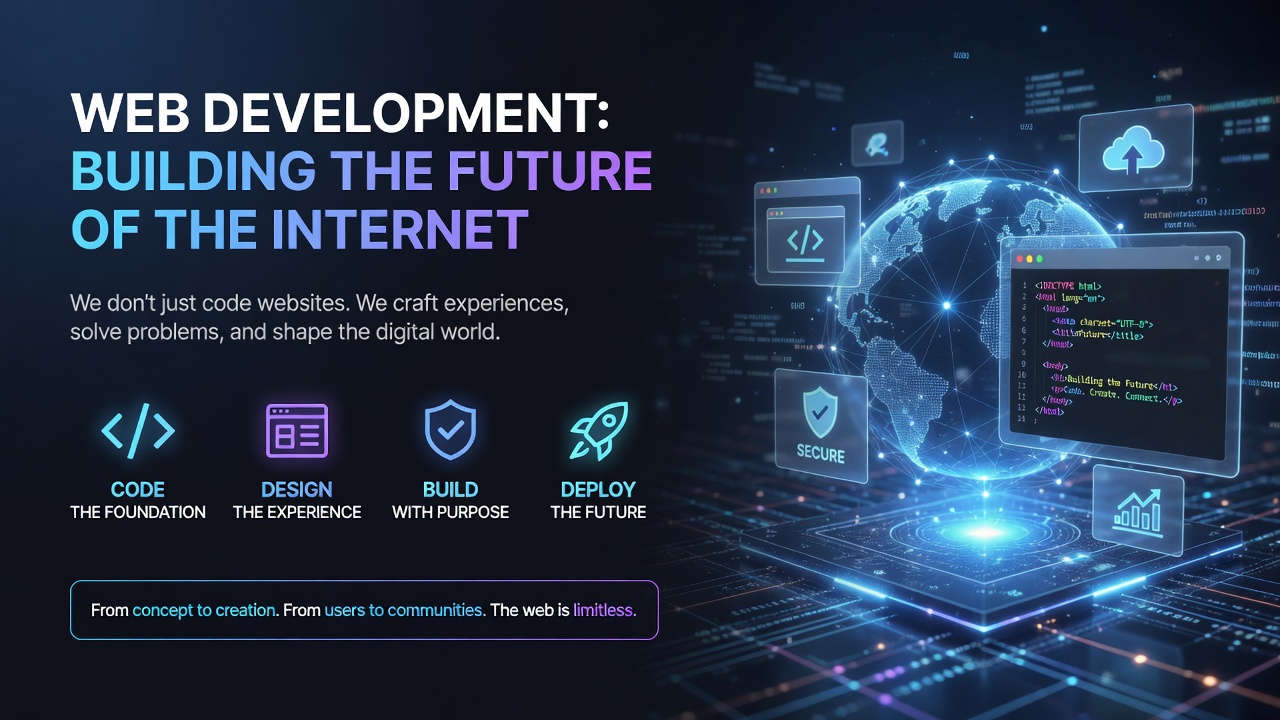
Every digital interaction we experience today—from reading an informative article, purchasing an item online, streaming high-definition media, to executing complex financial transactions—relies on web development. Web development is the structural, logical, and artistic framework that creates the virtual landscape of our modern world. It is the bridge between human intent and machine execution, translating code into accessible, interactive, and functional user interfaces.
As the internet matures, the standards for web infrastructure continue to skyrocket. A modern application or content platform must be lightning-fast, visually impeccable, highly secure, fully responsive across diverse devices, and perfectly optimized for discovery engines. Web development is no longer merely about writing a static page; it is about engineering dynamic ecosystems capable of scaling globally to handle massive traffic and complex computational loads.
This comprehensive architectural guide covers the foundational layers of frontend and backend technologies, analyzes database systems and performance optimization strategies, details essential security frameworks, and explores the emerging frontiers of web design and deployment.
2. Frontend Architecture: Engineering the User Interface
The frontend is the presentation layer of a web application. It is the digital real estate that users directly see, touch, and interact with. Building an efficient frontend requires a balance between aesthetic execution, accessibility standards, and runtime performance.
The Core Triad: HTML5, CSS3, and JavaScript
- HTML5 (The Skeleton): HyperText Markup Language forms the semantic foundation of any webpage. Modern web development prioritizes semantic HTML elements (like
<article>,<section>,<nav>, and<header>) over generic divs. This semantic clarity is vital because it explicitly informs search engine crawlers and screen readers about the structural value of the content, directly boosting Search Engine Optimization (SEO) and digital accessibility compliance. - CSS3 and Modern Styling (The Skin): Cascading Style Sheets govern the visual design, layouts, typography, and aesthetic flow. Modern workflows have shifted away from heavy, manual positioning toward robust native layout systems like CSS Grid and Flexbox. Additionally, utility-first frameworks like Tailwind CSS allow developers to build pixel-perfect, highly maintainable responsive layouts natively within components, speeding up production.
- JavaScript / TypeScript (The Muscles): JavaScript provides the programming logic that makes pages interactive. In institutional and enterprise environments, standard JavaScript is heavily augmented or replaced by TypeScript. TypeScript adds static typing to the language, enabling developers to catch code errors during compilation rather than execution, making large-scale codebases significantly more stable and easier to debug.
The Component Framework Era
Modern frontend engineering has evolved from managing individual pages to building scalable architectures composed of reusable UI components. Libraries and frameworks like React, Vue.js, and Angular allow developers to build interfaces where the UI automatically reflects the underlying data state. This componentized approach makes updating major websites exceptionally predictable and efficient, allowing a single structural layout to safely populate thousands of dynamic informational pages.
3. Backend Infrastructure: The Engine of Logic and Data
While the frontend controls the visual presentation, the backend acts as the unseen engine room of the application. It manages business logic, authenticates user sessions, handles server-side computing, and communicates directly with database engines.
Server Environments and Ecosystems
Developers select runtime environments and programming frameworks based on data concurrency requirements, computational loads, and execution speed:
- Node.js (JavaScript/TypeScript): Powered by Google’s V8 engine, Node.js utilizes an asynchronous, event-driven, non-blocking I/O model. This makes it incredibly efficient for real-time applications and data-intensive platforms that handle thousands of simultaneous connections.
- Python (Django / FastAPI): Renowned for clean syntax and robust development speeds. Django follows a “batteries-included” philosophy, providing built-in authentication and database administration tools out of the box, making it highly reliable for secure corporate applications.
- PHP (Laravel): PHP remains an absolute powerhouse of the web, powering a massive percentage of modern content platforms and content management systems. Frameworks like Laravel modernize PHP development with elegant syntax, automated routing, object-relational mapping (ORM), and structured security modules.
Application Programming Interfaces (APIs)
APIs are the dedicated communication pathways that connect disparate digital systems. They allow the frontend to safely request and receive structured data from the backend, and enable integration with external web services.
4. Database Architecture: Organizing Global Information
Data persistence is mandatory for any dynamic web application. Choosing the right database paradigm dictates how safely information is stored, how fast queries execute, and how efficiently an application scales under heavy analytical or traffic demands.
Relational Databases (SQL)
Relational databases—such as PostgreSQL and MySQL—organize data into highly structured, pre-defined tables linked by explicit relationships. They adhere strictly to ACID properties (Atomicity, Consistency, Isolation, Durability), ensuring that every database transaction is executed flawlessly or completely rolled back. This absolute structural consistency makes SQL databases the mandatory choice for financial logs, e-commerce transactions, user authentication profiles, and structured analytical data fields.
Non-Relational Databases (NoSQL)
Non-relational databases—such as MongoDB—store data as flexible, schema-less JSON documents. This document-oriented approach eliminates the rigid constraints of traditional tables. NoSQL databases are exceptionally proficient at storing unstructured data formats, handling rapid horizontal scaling across multiple servers, and accommodating high-velocity data pipelines where content schemas frequently change or evolve over time.
5. Performance Optimization and Mobile-First Architecture
In web development, speed is not a luxury—it is a core business requirement. Slow load times directly degrade user experience, spike bounce rates, and cause devastating drops in search engine visibility. Modern optimization requires a multi-faceted technical strategy.
Core Web Vitals and Page Performance Metrics
Google utilizes a specific set of real-world metrics, known as Core Web Vitals, to score the user experience and speed of a webpage. Developers build and tune systems to maximize performance across three primary vectors:
| Web Vital Metric | Technical Definition | Target Performance Threshold |
|---|---|---|
| Largest Contentful Paint (LCP) | Measures loading performance. It marks the time at which the main content of a page has likely loaded. | Under 2.5 seconds |
| Interaction to Next Paint (INP) | Measures UI responsiveness. Tracks how fast a page responds to every user interaction (clicks, taps, inputs). | Under 200 milliseconds |
| Cumulative Layout Shift (CLS) | Measures visual stability. Tracks whether elements jump or shift unexpectedly while page resources are downloading. | Less than 0.1 |
Critical Optimization Techniques
- Responsive Asset Delivery: Utilizing modern image formats like WebP or AVIF instead of legacy JPEGs or PNGs drastically slashes payload size. Images should always implement lazy-loading attributes so they only download as the user scrolls them into view.
- Code Splitting and Minification: Compressing raw HTML, CSS, and JavaScript files by removing unnecessary whitespace and shortening variable names reduces network transport times. Code splitting divides large JavaScript application bundles into smaller files, downloading only the specific code required to render the active view.
- Content Delivery Networks (CDNs): Storing static assets (images, HTML files, stylesheets) on a globally distributed network of edge servers (e.g., Cloudflare, AWS CloudFront). When a user requests a page, the assets are served from the closest physical geographic server, bypassing latency delays.
6. Security Frameworks: Shielding the Application
Web applications are exposed to constant scanning and malicious exploitation attempts by automated scripts and bad actors. Implementing security protocols right from the foundational code layer is a mandatory requirement for data integrity and user trust.
The Defenses Against the OWASP Top 10
The Open Worldwide Application Security Project (OWASP) maintains the definitive index of critical web application vulnerabilities. Developers mitigate these threats through strict engineering practices:
- Input Sanitization and Parametrized Queries: To permanently neutralize SQL Injection attacks—where hackers attempt to insert malicious database commands into input forms—developers utilize object-relational mapping tools or parameterized queries. This ensures all user inputs are treated strictly as harmless data strings, never as executable code instructions.
- Cross-Site Scripting (XSS) Defenses: XSS occurs when an attacker successfully injects a malicious script into a trusted website, compromising user browser sessions. Developers combat this by properly escaping output strings, sanitizing rich-text inputs, and enforcing strict Content Security Policies (CSP) via HTTP headers to restrict where scripts can safely execute from.
- Data Encryption in Transit and Rest: Every professional web asset must enforce HTTPS utilizing Transport Layer Security (TLS) certificates to encrypt communication between the browser and the host server. Sensitive data stored on databases must simultaneously utilize strong underlying encryption standards (like AES-256).
7. DevOps and Deployment Architecture: Going Live
The boundary separating web software engineering and infrastructure management has largely dissolved due to the rise of DevOps. DevOps focuses on automating the integration, deployment, and scaling of web assets.
Continuous Integration / Continuous Deployment (CI/CD)
Manual server uploads via FTP are obsolete. Modern web deployment relies on automated CI/CD pipelines (e.g., GitHub Actions, GitLab CI). When code is pushed to a repository, the pipeline triggers automated test suites to ensure no bugs or security vulnerabilities are introduced. If the tests pass cleanly, the application is automatically built and deployed to production servers without human intervention.
Serverless and Edge Infrastructure
Modern applications are increasingly breaking away from traditional, always-running cloud servers. Serverless Computing platforms (like AWS Lambda) execute backend code functions entirely on-demand, scaling computing power up or down automatically and billing companies only for the exact milliseconds of execution time used. Going a step further, Edge Computing deploys serverless functions directly onto CDN node servers globally, meaning simple backend computations execute milliseconds away from the user’s physical device, removing traditional network latency.
8. Future Horizons: The Convergence of WebAssembly and AI
The web is undergoing a massive transformation, breaking past the historical performance limitations of standard browser environments.
WebAssembly (Wasm) is a low-level binary format that runs inside modern browsers at near-native execution speeds. Wasm enables developers to compile code written in heavy systems languages like C++, Rust, or Go directly for the web. This allows complex software traditionally restricted to desktop installations—such as high-fidelity video editors, 3D engines, intensive data modeling dashboards, and heavy graphic tools—to execute flawlessly inside standard web browsers, even on mobile devices.
Concurrently, Artificial Intelligence Integration is fundamentally shifting how web layouts operate. Rather than serving static structures to every user, future frameworks leverage machine learning to analyze context, user preferences, and real-time interaction metrics to adapt layouts dynamically. Furthermore, conversational interfaces, automated code debugging workflows, and algorithmic optimization of search parameters are making the web vastly more accessible, fast, and responsive to individual human needs.
Frequently Asked Questions (FAQ)
5. Performance Optimization and Mobile-First Architecture
In web development, speed is not a luxury—it is a core business requirement. Slow load times directly degrade user experience, spike bounce rates, and cause devastating drops in search engine visibility. Modern optimization requires a multi-faceted technical strategy.
Core Web Vitals and Page Performance Metrics
Google utilizes a specific set of real-world metrics, known as Core Web Vitals, to score the user experience and speed of a webpage. Developers build and tune systems to maximize performance across three primary vectors:
| Web Vital Metric | Technical Definition | Target Performance Threshold |
|---|---|---|
| Largest Contentful Paint (LCP) | Measures loading performance. It marks the time at which the main content of a page has likely loaded. | Under 2.5 seconds |
| Interaction to Next Paint (INP) | Measures UI responsiveness. Tracks how fast a page responds to every user interaction (clicks, taps, inputs). | Under 200 milliseconds |
| Cumulative Layout Shift (CLS) | Measures visual stability. Tracks whether elements jump or shift unexpectedly while page resources are downloading. | Less than 0.1 |
Critical Optimization Techniques
- Responsive Asset Delivery: Utilizing modern image formats like WebP or AVIF instead of legacy JPEGs or PNGs drastically slashes payload size. Images should always implement lazy-loading attributes so they only download as the user scrolls them into view.
- Code Splitting and Minification: Compressing raw HTML, CSS, and JavaScript files by removing unnecessary whitespace and shortening variable names reduces network transport times. Code splitting divides large JavaScript application bundles into smaller files, downloading only the specific code required to render the active view.
- Content Delivery Networks (CDNs): Storing static assets (images, HTML files, stylesheets) on a globally distributed network of edge servers (e.g., Cloudflare, AWS CloudFront). When a user requests a page, the assets are served from the closest physical geographic server, bypassing latency delays.
6. Security Frameworks: Shielding the Application
Web applications are exposed to constant scanning and malicious exploitation attempts by automated scripts and bad actors. Implementing security protocols right from the foundational code layer is a mandatory requirement for data integrity and user trust.
The Defenses Against the OWASP Top 10
The Open Worldwide Application Security Project (OWASP) maintains the definitive index of critical web application vulnerabilities. Developers mitigate these threats through strict engineering practices:
- Input Sanitization and Parametrized Queries: To permanently neutralize SQL Injection attacks—where hackers attempt to insert malicious database commands into input forms—developers utilize object-relational mapping tools or parameterized queries. This ensures all user inputs are treated strictly as harmless data strings, never as executable code instructions.
- Cross-Site Scripting (XSS) Defenses: XSS occurs when an attacker successfully injects a malicious script into a trusted website, compromising user browser sessions. Developers combat this by properly escaping output strings, sanitizing rich-text inputs, and enforcing strict Content Security Policies (CSP) via HTTP headers to restrict where scripts can safely execute from.
- Data Encryption in Transit and Rest: Every professional web asset must enforce HTTPS utilizing Transport Layer Security (TLS) certificates to encrypt communication between the browser and the host server. Sensitive data stored on databases must simultaneously utilize strong underlying encryption standards (like AES-256).
7. DevOps and Deployment Architecture: Going Live
The boundary separating web software engineering and infrastructure management has largely dissolved due to the rise of DevOps. DevOps focuses on automating the integration, deployment, and scaling of web assets.
Continuous Integration / Continuous Deployment (CI/CD)
Manual server uploads via FTP are obsolete. Modern web deployment relies on automated CI/CD pipelines (e.g., GitHub Actions, GitLab CI). When code is pushed to a repository, the pipeline triggers automated test suites to ensure no bugs or security vulnerabilities are introduced. If the tests pass cleanly, the application is automatically built and deployed to production servers without human intervention.
Serverless and Edge Infrastructure
Modern applications are increasingly breaking away from traditional, always-running cloud servers. Serverless Computing platforms (like AWS Lambda) execute backend code functions entirely on-demand, scaling computing power up or down automatically and billing companies only for the exact milliseconds of execution time used. Going a step further, Edge Computing deploys serverless functions directly onto CDN node servers globally, meaning simple backend computations execute milliseconds away from the user’s physical device, removing traditional network latency.
8. Future Horizons: The Convergence of WebAssembly and AI
The web is undergoing a massive transformation, breaking past the historical performance limitations of standard browser environments.
WebAssembly (Wasm) is a low-level binary format that runs inside modern browsers at near-native execution speeds. Wasm enables developers to compile code written in heavy systems languages like C++, Rust, or Go directly for the web. This allows complex software traditionally restricted to desktop installations—such as high-fidelity video editors, 3D engines, intensive data modeling dashboards, and heavy graphic tools—to execute flawlessly inside standard web browsers, even on mobile devices.
Concurrently, Artificial Intelligence Integration is fundamentally shifting how web layouts operate. Rather than serving static structures to every user, future frameworks leverage machine learning to analyze context, user preferences, and real-time interaction metrics to adapt layouts dynamically. Furthermore, conversational interfaces, automated code debugging workflows, and algorithmic optimization of search parameters are making the web vastly more accessible, fast, and responsive to individual human needs.
Frequently Asked Questions (FAQ)