Introduction
The dawn of the twenty-first century has brought about a paradigm shift in how computing systems operate, transitioning from strict, logic-based programming to adaptive, data-driven methodologies. At the heart of this transformation lies Machine Learning technology. Over the past decade, this field has transitioned from theoretical computer science laboratories into the very fabric of our daily lives, influencing everything from the media we consume to the medical treatments we receive. As we generate unprecedented volumes of data, the ability to extract actionable insights and predictive foresight from this information has become paramount. Machine learning serves as the critical engine powering this capability, transforming vast, chaotic data lakes into structured, intelligent decisions. The continuous evolution of Machine Learning applications is reshaping traditional industries, creating novel economic paradigms, and establishing an entirely new landscape of Machine Learning careers. Understanding this intricate technology is no longer optional for forward-thinking professionals; it is a fundamental requirement for navigating the modern digital economy and preparing for the future of Machine Learning.
Meaning and Concept of Machine Learning
At its core, Machine Learning is a specialized subfield of artificial intelligence dedicated to the design and development of algorithms that enable computers to learn from and make predictions or decisions based on data. Traditional software engineering relies on deterministic programming, where a human developer explicitly writes rules and instructions for the computer to follow in order to solve a specific problem. For example, if a programmer wants a computer to sort a list of numbers, they write a sorting algorithm detailing every operational step.
Machine Learning flips this traditional paradigm entirely. Instead of writing explicit rules to process inputs into outputs, engineers provide the computer with massive amounts of input data and the corresponding desired outputs. The Machine Learning algorithms then analyze this data to independently discover the underlying mathematical patterns, relationships, and rules. Once the system has successfully “learned” these rules, it forms what is known as a model. This trained model can then be deployed to evaluate new, previously unseen data and make highly accurate predictions or autonomous decisions. The foundational concept is continuous improvement: as the system is exposed to more data over time, its performance, accuracy, and operational efficiency incrementally improve without requiring any manual human intervention or code adjustments.
History and Evolution of Machine Learning
The theoretical foundations of Machine Learning trace back to the mid-twentieth century, rooted in the broader quest to create artificial intelligence. In 1950, British mathematician and computer scientist Alan Turing proposed the “Turing Test,” challenging the scientific community to consider whether machines could exhibit intelligent behavior indistinguishable from that of a human. However, the specific term “Machine Learning” was coined in 1959 by Arthur Samuel, an IBM researcher who developed a self-learning program capable of playing checkers. Samuel’s program was revolutionary because it was designed to study previous games, evaluate board positions, and calculate the probability of winning based on its own accumulated experience, eventually learning to play better than its creator.
During the 1960s and 1970s, research shifted toward probabilistic reasoning and pattern recognition. Frank Rosenblatt invented the Perceptron in 1957, which was the earliest artificial neural network capable of basic binary classification. Despite early optimism, the field experienced a significant stagnation known as the “AI Winter” in the 1970s and 1980s, primarily due to severe limitations in computational power and the lack of digital data. The true renaissance of Machine Learning occurred in the 1990s and 2000s, driven by the advent of the internet, the exponential increase in data generation, and the realization of Moore’s Law, which provided cheap, ubiquitous computational power. By the 2010s, the emergence of deep learning architectures, powered by advanced Graphical Processing Units (GPUs), shattered previous performance benchmarks in image and speech recognition, solidifying Machine Learning as a transformative technological force.
Difference Between Artificial Intelligence, Machine Learning, and Deep Learning
To fully grasp the technological landscape, it is essential to distinguish between Artificial Intelligence (AI), Machine Learning (ML), and Deep Learning (DL), as these terms are frequently, yet incorrectly, used interchangeably.
Artificial Intelligence is the broadest overarching concept. It refers to the generalized goal of creating machines or software capable of mimicking human cognitive functions, such as reasoning, problem-solving, understanding natural language, and visual perception. AI encompasses a wide array of techniques, including rule-based expert systems and symbolic logic, which do not necessarily involve learning from data.
Machine Learning is a distinct subset of Artificial Intelligence. It provides the statistical techniques and algorithms that give AI systems the ability to learn and improve from experience without being explicitly programmed. If AI is the desired outcome—an intelligent machine—then Machine Learning is the primary vehicle used to achieve that outcome today.
Deep Learning is a highly specialized subset of Machine Learning. It focuses specifically on algorithms inspired by the structure and function of the human brain, known as artificial neural networks. Deep Learning models are characterized by having multiple layers (hence “deep”) that process data hierarchically. While traditional Machine Learning algorithms often require human engineers to manually select and extract relevant features from the data, Deep Learning algorithms can automatically extract features directly from raw data, making them exceptionally powerful for complex tasks like computer vision and natural language processing, provided they have access to massive datasets.
“A computer would deserve to be called intelligent if it could deceive a human into believing that it was human.” – Alan Turing
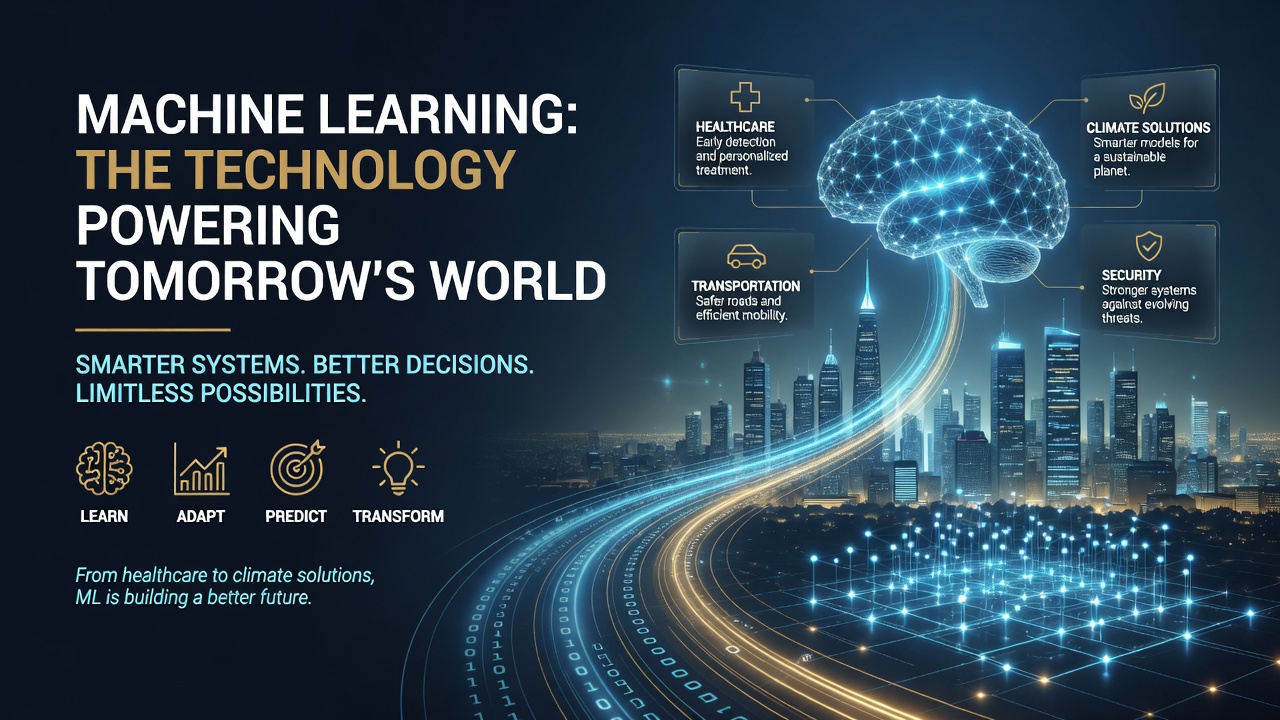
Why Machine Learning Is the Technology Powering Tomorrow’s World
The assertion that Machine Learning is the primary technology shaping our future is not hyperbole; it is a reality driven by a convergence of technological, economic, and societal factors. The modern world operates on an infrastructure of digital information. Every digital interaction, financial transaction, sensor reading, and social media post generates data. Human cognitive capacity is vastly insufficient to process, analyze, or derive meaning from this astronomical volume of information. Machine Learning algorithms scale effortlessly to meet this challenge, uncovering subtle correlations and insights that would remain permanently hidden from human analysts.
Key Benefits of Machine Learning
- Rapid Processing of Massive Datasets: Algorithms can ingest and analyze petabytes of multi-dimensional data across disparate sources in near real-time, facilitating instantaneous decision-making in critical environments.
- Automation of Complex Cognitive Tasks: Tasks that previously required human judgment, such as visual inspection, text summarization, and anomaly detection, can now be reliably automated at scale.
- Unprecedented Personalization: By analyzing individual user behavior, ML enables highly tailored experiences in e-commerce, digital entertainment, healthcare, and education, maximizing engagement and outcomes.
- Continuous Self-Improvement: Unlike static software that degrades in utility as environments change, ML models dynamically adapt to new data, ensuring that performance improves or remains optimal over time.
- Proactive and Predictive Capabilities: Instead of merely reacting to historical events, ML empowers organizations to predict future trends, user behaviors, and system failures before they occur.
How Machine Learning Works
The operational lifecycle of a Machine Learning system is a highly structured, iterative process designed to transform raw information into actionable intelligence. While the mathematical underpinnings can be incredibly complex, the conceptual workflow generally follows a standard pipeline.
The process begins with the formulation of a problem and the gathering of relevant data. This data acts as the textbook from which the algorithm will learn. Once the data is prepared, a specific algorithm is selected based on the nature of the problem. During the training phase, the algorithm iteratively processes the data, making preliminary predictions and comparing them against the actual desired outcomes. By calculating the error—the difference between its prediction and the truth—the algorithm meticulously adjusts its internal mathematical weights and parameters to minimize this error in subsequent attempts. This iterative adjustment continues millions of times until the algorithm reaches an acceptable level of accuracy. At this point, the trained model is evaluated using a separate set of test data to ensure it can generalize its knowledge to new, unseen scenarios. Finally, the validated model is deployed into a production environment where it begins serving its intended purpose, continually monitoring incoming data to make real-time predictions.
Core Components of Machine Learning Systems
A robust and functional Machine Learning ecosystem is built upon several indispensable components. The most critical element is the Dataset, which must be voluminous, diverse, and meticulously curated. Without high-quality data, even the most sophisticated algorithm will fail—a principle commonly known in computer science as “garbage in, garbage out.”
The second component is the Algorithm itself, which is the mathematical procedure used to parse the data. Algorithms range from simple statistical equations to massive networks of artificial neurons. The third component is the resulting Model, which is the mathematical representation of the patterns learned by the algorithm. Think of the algorithm as the factory process and the model as the final manufactured product that actually performs the work.
Finally, modern Machine Learning is entirely dependent on vast Compute Power. Training complex models requires performing trillions of matrix multiplications and floating-point operations. This necessitates specialized hardware, specifically Graphical Processing Units (GPUs) and Tensor Processing Units (TPUs), distributed across massive cloud computing data centers.
Types of Machine Learning
Machine Learning is not a monolithic discipline; it is categorized into distinct paradigms based on how the algorithms are trained and the type of data they consume. Understanding these categories is fundamental to applying the correct Machine Learning applications to specific business or scientific problems.
Supervised Learning
Supervised Learning is the most prevalent and widely deployed form of Machine Learning in the industry today. In this paradigm, the algorithm is trained on a “labeled” dataset. This means that every piece of input data is explicitly paired with the correct output or answer. The goal of supervised learning is to map the input variables to the output variables so accurately that when new input data is introduced, the algorithm can successfully predict the correct output. Common applications include email spam filtering, where thousands of emails are labeled as either “spam” or “not spam,” teaching the algorithm the characteristics of each category.
Unsupervised Learning
In stark contrast to supervised learning, Unsupervised Learning involves training an algorithm on data that has no explicit labels, categories, or correct answers provided. The algorithm is left entirely on its own to explore the data and discover hidden structures, patterns, or relationships. The primary goal is often to group similar data points together or to reduce the complexity of the data without losing its inherent meaning. Unsupervised learning is frequently utilized for customer segmentation in marketing, where a business wants to group customers with similar purchasing behaviors without defining those groups in advance.
Semi-Supervised Learning
Semi-supervised Learning represents a pragmatic middle ground between supervised and unsupervised learning. In many real-world scenarios, acquiring large amounts of raw data is cheap and easy, but manually labeling that data is expensive, time-consuming, and requires specialized human experts. Semi-supervised learning addresses this bottleneck by using a small amount of labeled data in conjunction with a massive amount of unlabeled data. The algorithm uses the small labeled dataset to learn the basic concepts, and then applies that knowledge to explore and categorize the much larger unlabeled dataset, significantly improving its own accuracy with minimal human effort.
Reinforcement Learning
Reinforcement Learning is a behavioral learning model fundamentally different from the others. It is based on the concept of an “agent” taking actions within a defined “environment” in order to maximize a cumulative “reward.” The algorithm is not told which actions to take; instead, it must discover which actions yield the highest reward by trying them out through extensive trial and error. Over time, the agent develops a complex strategy, or policy, to navigate its environment optimally. This type of learning is the driving force behind breakthroughs in autonomous robotics, self-driving cars, and AI systems capable of defeating human champions in complex games like Chess and Go.
| Learning Type | Data Requirement | Primary Objective | Common Applications |
|---|---|---|---|
| Supervised Learning | Fully labeled dataset | Predict outcomes for new data | Image classification, price prediction |
| Unsupervised Learning | Unlabeled dataset | Discover hidden patterns/groupings | Customer segmentation, anomaly detection |
| Semi-Supervised | Mix of labeled and unlabeled | Improve accuracy with minimal labels | Web page classification, speech recognition |
| Reinforcement Learning | Interactive environment feedback | Learn optimal action strategies | Robotics, autonomous navigation, gaming AI |
Machine Learning Algorithms
The theoretical concepts of Machine Learning are executed through specific mathematical algorithms. A skilled Machine Learning engineer must understand the nuances, strengths, and weaknesses of various algorithms to select the most appropriate tool for a given dataset and business objective.
Linear Regression
Linear Regression is one of the foundational algorithms in statistics and Machine Learning. It is utilized exclusively for predictive modeling when the target variable is continuous and numeric. The algorithm attempts to model the relationship between a dependent variable and one or more independent variables by fitting a linear equation (a straight line) to the observed data. For example, linear regression can be used to predict the future price of a house based on quantitative features such as its square footage, age, and distance from the city center.
Logistic Regression
Despite the word “regression” in its name, Logistic Regression is fundamentally a classification algorithm. It is used when the desired output is binary, meaning there are only two possible outcomes (e.g., Yes/No, True/False, Success/Failure). Instead of fitting a straight line, it uses a complex mathematical function called a sigmoid curve to estimate the probability that a given instance belongs to a specific class. If the calculated probability is greater than 50%, the algorithm classifies the instance into the positive class. It is widely used in medicine to predict the probability of a patient developing a particular disease based on their health metrics.
Decision Trees
A Decision Tree is a highly intuitive, versatile algorithm capable of performing both classification and regression tasks. It builds a model in the structural form of a tree, where each internal node represents a test or question regarding a specific data feature, each branch represents the outcome of that test, and each leaf node represents the final decision or prediction. Decision trees are highly valued in the industry because they are highly interpretable; human analysts can easily trace the path from the root to the leaf to understand exactly why the algorithm made a specific decision.
Random Forest
A Random Forest is a powerful ensemble learning method that significantly improves upon the foundation of a single decision tree. Because individual decision trees are prone to “overfitting” (memorizing the training data rather than learning general patterns), a Random Forest constructs a multitude of decision trees during the training phase. When a prediction is required, the algorithm aggregates the predictions from all the individual trees and outputs the mode of the classes (for classification) or the mean prediction (for regression). This ensemble approach greatly enhances the model’s accuracy, stability, and resistance to noisy data.
Support Vector Machines (SVM)
Support Vector Machines are highly effective classification algorithms particularly suited for high-dimensional data spaces. The core objective of an SVM is to find the optimal hyperplane—a multi-dimensional boundary—that distinctly separates different categories of data points with the maximum possible margin. The data points that lie closest to this dividing boundary are known as support vectors, as they dictate the exact position and orientation of the hyperplane. SVMs are incredibly powerful for complex text categorization, biometric data analysis, and intricate image recognition tasks.
Neural Networks
Artificial Neural Networks are biologically inspired algorithms modeled after the synaptic connections of the human brain. They consist of layers of interconnected artificial neurons, or nodes. Data is fed into the input layer, aggressively processed and mathematically transformed through multiple hidden layers, and finally evaluated at the output layer. The complex, non-linear relationships that neural networks can map make them the undisputed champions for dealing with highly unstructured data, such as audio files, raw text, and high-resolution images.
Clustering Algorithms
Clustering algorithms, predominantly K-Means Clustering, are the workhorses of unsupervised learning. Their primary function is to divide a dataset into distinct groups, or clusters, such that data points within the same cluster are highly similar to each other, while data points in different clusters are highly dissimilar. The algorithm iteratively calculates the geographic center (centroid) of each cluster and reassigns data points to the nearest centroid until the groupings stabilize. This is exceptionally useful in market research, bioinformatics, and document organization.
| Algorithm | Category | Best Used For |
|---|---|---|
| Linear Regression | Supervised | Predicting continuous numeric values (e.g., sales, temperature) |
| Logistic Regression | Supervised | Binary classification tasks (e.g., spam detection, pass/fail) |
| Random Forest | Supervised | High accuracy classification and regression on complex datasets |
| Neural Networks | Deep Learning | Complex unstructured data (e.g., computer vision, NLP) |
| K-Means Clustering | Unsupervised | Segmenting data into similar groups without prior labels |
Importance of Data in Machine Learning
In the realm of artificial intelligence, data is universally recognized as the foundational currency. The most elegant, mathematically advanced algorithm is entirely useless without a substantial, high-quality dataset to learn from. Machine Learning systems do not possess innate intuition or common sense; their entire understanding of the world is strictly limited to the data they ingest. Therefore, the quantity, quality, and diversity of the data dictate the ceiling of the model’s performance. Furthermore, data acts as the ultimate equalizer in the tech industry. Companies possessing massive proprietary datasets hold a significant competitive advantage, often outpacing competitors who might have superior software engineers but inferior data resources.
Data Collection and Data Processing
The journey from raw information to a functional Machine Learning model is heavily dependent on data engineering. Data collection involves scraping web pages, querying relational databases, utilizing application programming interfaces (APIs), and gathering telemetry from IoT sensors to construct a comprehensive dataset. However, raw data is inherently chaotic. It contains missing values, duplicate entries, formatting errors, and statistical outliers.
Data processing, therefore, is an exhaustive phase of cleaning and preparation. Data scientists spend the majority of their time executing processes such as data normalization (scaling numerical values to a standard range), data imputation (intelligently filling in missing data points), and categorical encoding (converting text labels into numerical formats that mathematical algorithms can comprehend). Without rigorous data processing, the resulting model will suffer from severe inaccuracies and biased predictions.
Training and Testing Machine Learning Models
Once the data is meticulously prepared, the critical phases of training and testing commence. To evaluate a model effectively, engineers must never test the model on the exact same data it used for training; doing so would be akin to giving a student the answer key before an exam. Instead, the total dataset is split into two distinct segments: a training set (typically 80% of the data) and a testing set (the remaining 20%).
During the training phase, the algorithm analyzes the training set, adjusting its internal parameters to map inputs to outputs. Once training is complete, the model’s true capability is assessed using the testing set. Because the model has never encountered the testing data before, its performance on this dataset provides an accurate metric of its ability to generalize to real-world scenarios. Engineers monitor for two critical failure modes during this phase: Overfitting (where the model memorizes the training data perfectly but fails utterly on the test data) and Underfitting (where the model is too simplistic to capture the underlying patterns in either dataset).
Machine Learning in Everyday Life
While the theoretical mathematics of Machine Learning can seem incredibly abstracted from reality, its practical applications permeate our daily existence. Without realizing it, the average consumer interacts with dozens of machine learning models on a daily basis. From the moment we unlock our smartphones using biometric facial recognition—a deep learning model analyzing facial geometry—to the predictive text suggesting our next word in a messaging application, ML algorithms are quietly operating in the background, continuously optimizing our digital interactions for maximum convenience and efficiency.
Machine Learning in Search Engines
Modern search engines represent one of the most complex and heavily utilized Machine Learning applications on the planet. Gone are the days when search engines simply matched the exact keywords typed into a search bar with keywords found on a web page. Today, engines like Google utilize sophisticated Natural Language Processing (NLP) models, such as BERT and RankBrain, to understand the nuanced semantic intent behind a user’s query.
These algorithms analyze contextual clues, user location, search history, and the intricate relationships between words to deduce what the user is actually seeking, even if they misspelled words or used ambiguous phrasing. Furthermore, Machine Learning dictates the ranking of the results, analyzing billions of web pages in milliseconds and predicting which specific page has the highest probability of satisfying the user’s underlying intent.
Machine Learning in Social Media
Social media platforms are entirely architected around Machine Learning algorithms designed to maximize user engagement and retention. The timeline or feed presented to a user is not a chronological list of posts; it is a highly curated, personalized stream dictated by complex recommendation engines. These algorithms continuously analyze a user’s behavior—tracking which posts they hover over, what content they like, share, or comment on, and the demographics of the accounts they interact with.
By processing this behavioral data, the model predicts with startling accuracy what type of content will keep the user scrolling for the longest possible duration. Beyond content curation, Machine Learning is also deployed for automated content moderation. Computer vision and NLP algorithms scan millions of images, videos, and text posts per minute, automatically flagging or removing content that violates platform policies regarding hate speech, graphic violence, or copyright infringement.
Machine Learning in Recommendation Systems
The digital economy relies heavily on recommendation systems to drive sales and content consumption. Streaming giants like Netflix and Spotify, alongside e-commerce behemoths like Amazon, owe a significant portion of their revenue to their Machine Learning recommendation engines. These systems primarily utilize two methodologies: collaborative filtering and content-based filtering.
Collaborative filtering analyzes the behavior of millions of users to find patterns; if User A and User B have similar historical tastes, the system will recommend content enjoyed by User B to User A. Content-based filtering, conversely, analyzes the attributes of the items themselves, recommending movies with similar genres, actors, or themes to those a user has previously consumed. These highly personalized recommendations transform massive digital catalogs into individualized storefronts, significantly reducing decision fatigue for the consumer.
Machine Learning in Healthcare
The integration of Machine Learning technology into the healthcare sector is rapidly revolutionizing modern medicine, shifting the paradigm from reactive treatments to proactive, personalized care. One of the most profound applications is in medical imaging and diagnostics. Deep learning computer vision models have been trained on millions of annotated X-rays, MRIs, and CT scans. Today, these algorithms can detect minute anomalies, such as early-stage tumors, microscopic fractures, or retinal diseases, often with a level of accuracy and speed that surpasses human radiologists.
Beyond diagnostics, Machine Learning is accelerating the complex process of drug discovery. By analyzing massive biological datasets and simulating molecular interactions, ML algorithms can predict how different chemical compounds will behave, significantly reducing the years of laboratory trial-and-error traditionally required to bring a new pharmaceutical drug to market. Additionally, predictive models are used in hospital administration to forecast patient admission rates, optimize bed allocation, and predict the likelihood of patient readmission based on historical electronic health records.
Machine Learning in Finance
The financial industry has been a pioneering adopter of Machine Learning technology, leveraging vast amounts of historical financial data to optimize operations, mitigate risk, and generate profit. In the realm of algorithmic trading, high-frequency ML models ingest real-time market data, global news sentiment, and economic indicators to execute millions of trades per second, capitalizing on microscopic market inefficiencies faster than any human trader could perceive.
Equally critical is the application of Machine Learning in fraud detection. Credit card companies employ real-time anomaly detection algorithms that analyze the geographic location, transaction size, purchasing frequency, and historical behavior of every single swipe. If a transaction deviates significantly from a user’s established pattern, the ML model flags it as potential fraud and temporarily freezes the account within milliseconds. Furthermore, traditional credit scoring models are being augmented by ML, which can analyze alternative data sources—such as utility payments and digital behavior—to extend credit to individuals lacking traditional financial histories.