Introduction
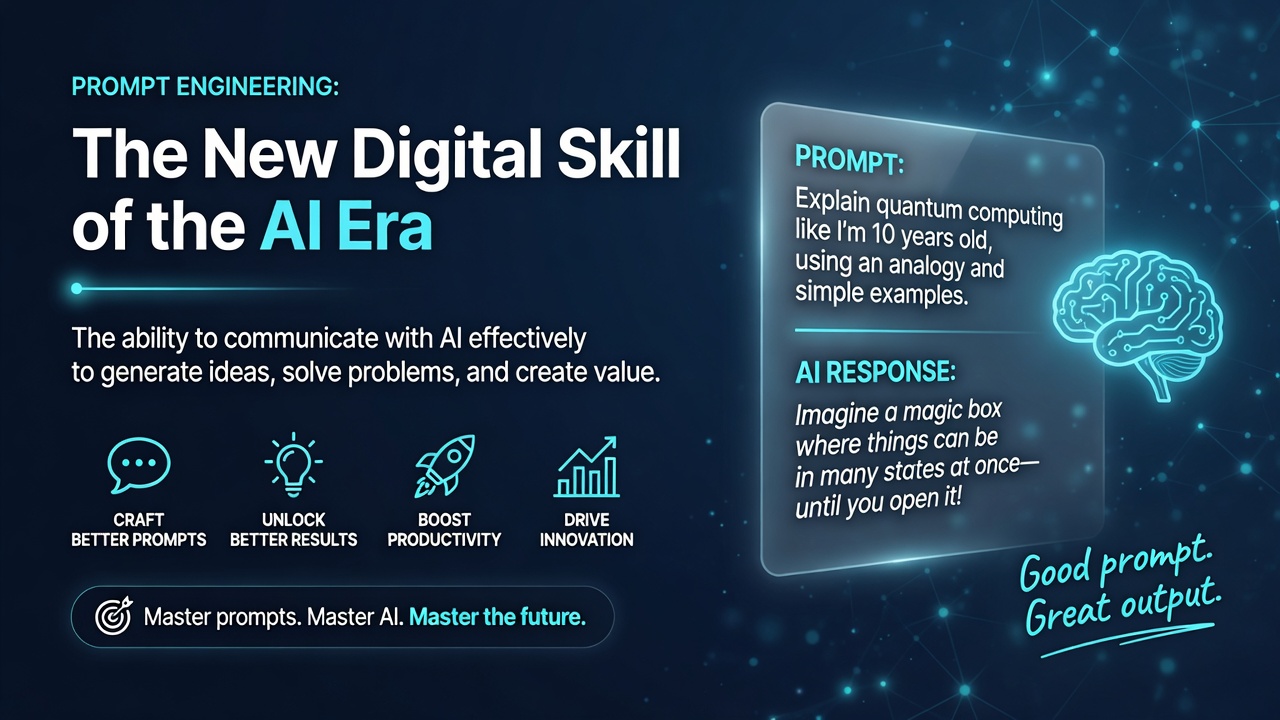
The sudden democratization of Artificial Intelligence, primarily driven by the public release of Large Language Models (LLMs), has fundamentally altered the landscape of digital work. We have transitioned from an era where humans had to learn the rigid, syntax-heavy languages of machines to an era where machines have finally learned the nuanced, context-heavy languages of humans. However, this linguistic bridge has created a new challenge: just because an AI can understand natural language does not mean it automatically understands human intent. The ability to articulate that intent with precision, to guide the AI’s vast but unfocused potential toward a specific, highly accurate output, has given rise to an entirely new discipline. This discipline, known as Prompt Engineering, is rapidly solidifying its position as the foundational digital skill of the AI era, essential for anyone looking to harness the true power of generative artificial intelligence.
Meaning and Concept of Prompt Engineering
At its core, Prompt Engineering is the practice of designing, structuring, and refining the text inputs—known as prompts—that are fed into generative AI models to elicit optimal responses. It is a unique blend of logic, linguistics, and domain expertise. A prompt is not merely a question; it is a set of programmable instructions delivered in natural language. If traditional programming involves writing deterministic code to tell a computer exactly what to do step-by-step, prompt engineering involves setting the psychological and contextual parameters for a probabilistic model to generate the desired result.
When a user provides a vague or poorly constructed prompt, the AI model is forced to guess the missing context, often resulting in generic, irrelevant, or hallucinatory outputs. Prompt Engineering mitigates this by providing the model with a clear framework. It involves defining the persona the AI should adopt, outlining the specific constraints it must follow, providing formatting guidelines, and sometimes even feeding the AI examples of the desired output. It is the art of constraint: narrowing the AI’s infinite possibilities down to the single most useful trajectory for the user’s specific workflow.
The Evolution: From Code to Natural Language
To understand the significance of Prompt Engineering, one must view it through the lens of computing history. Human-computer interaction has always been defined by the level of abstraction between human thought and machine execution. In the earliest days, humans communicated with machines via physical punch cards. This evolved into Assembly language, which was slightly more readable but still incredibly tedious. Then came high-level programming languages like C, Java, and Python, which allowed humans to write logic in a syntax resembling English, which compilers then translated into machine code.
Prompt Engineering represents the next massive leap in this evolutionary chain. The abstraction layer has moved entirely from structured code to natural conversational language. We are no longer programming the machine; we are managing it. The AI acts as a computational engine, and the prompt acts as the steering wheel. This shift is revolutionary because it drastically lowers the barrier to entry for technological creation. Individuals without formal computer science backgrounds can now develop software, analyze complex datasets, and automate workflows simply by mastering the linguistic art of the prompt.
“The hottest new programming language is English.” – Andrej Karpathy, Former Director of AI at Tesla
Difference Between Prompt Engineering, Fine-Tuning, and RAG
As organizations rush to implement AI, there is frequent confusion regarding how to adapt these models for specific business needs. It is crucial to distinguish Prompt Engineering from other AI adaptation techniques like Fine-Tuning and Retrieval-Augmented Generation (RAG).
- Prompt Engineering: This is a “time-of-inference” technique. The underlying AI model itself is not permanently changed or trained. The user is simply manipulating the input text to guide the model’s existing knowledge toward a specific output. It is fast, requires zero computational overhead, and is the first line of optimization.
- Fine-Tuning: This involves actually retraining an existing AI model on a new, specific dataset. By updating the model’s internal mathematical weights, it becomes a specialist in a particular domain (e.g., training a general medical AI to become an expert exclusively in oncology). Fine-tuning permanently alters the model and requires significant data, time, and computing power.
- Retrieval-Augmented Generation (RAG): RAG connects an AI model to an external database (like a company’s internal documents). When a user asks a question, the system first searches the database for relevant facts, retrieves them, and then includes those facts in the prompt sent to the AI. This allows the AI to answer based on proprietary, up-to-date information it was never originally trained on, drastically reducing hallucinations.
Core Components of an Effective Prompt
Mastering Prompt Engineering begins with moving beyond simple, single-sentence questions. A robust, professional-grade prompt is typically modular, built using a specific framework that provides the AI with all the necessary guardrails. While different practitioners use various acronyms, a highly effective prompt generally contains four primary pillars.
| Component | Description | Example |
|---|---|---|
| Persona / Role | Assigns a specific identity or professional expertise to the AI, forcing it to access domain-specific vocabulary and viewpoints. | “Act as a senior cybersecurity analyst with 15 years of enterprise experience…” |
| Task / Objective | The explicit action the AI needs to perform. This must be unambiguous and clearly defined. | “…write a comprehensive risk assessment report regarding the new software update…” |
| Context / Constraints | Background information, target audience, tone of voice, or specific rules the AI must not violate. | “…The audience is the executive board, who have no technical background. Keep the tone urgent but professional. Do not use complex jargon…” |
| Format / Output | The exact structure in which the final response should be delivered. | “…Format the report with an executive summary, followed by a 3-column markdown table, and end with actionable bullet points.” |
Advanced Prompting Techniques
Once the foundational structure of a prompt is mastered, engineers employ advanced cognitive frameworks to push the boundaries of what LLMs can achieve, particularly when dealing with complex reasoning, mathematics, or multi-step logic problems.
Zero-Shot and Few-Shot Prompting
Zero-Shot Prompting is the most common interaction method: asking the AI to perform a task without providing any prior examples. You rely entirely on the model’s pre-trained knowledge. For instance, “Translate the word ‘hello’ into French.”
Few-Shot Prompting is a technique used when zero-shot fails to produce the desired format or nuance. The engineer provides the AI with a few concrete examples of the input-output mapping within the prompt itself before asking the final question. By showing the AI the exact pattern, the model reliably mimics the desired structure. For example, providing three examples of a product review and its corresponding sentiment (Positive/Negative) before asking the AI to classify a fourth review.
Chain-of-Thought (CoT) Prompting
Chain-of-Thought is arguably the most powerful breakthrough in prompt engineering. LLMs are notorious for failing at complex logic because they try to predict the final answer immediately. CoT forces the model to break the problem down into intermediate, sequential steps. By simply adding phrases like “Let’s think step-by-step,” or by providing an example of a step-by-step deduction, the model generates its reasoning process visibly before arriving at the final conclusion. This drastically reduces mathematical and logical errors, as the model uses its own generated text as a scratchpad to guide its next calculation.
Tree of Thoughts (ToT)
An evolution of CoT, Tree of Thoughts allows the AI to explore multiple different reasoning paths simultaneously. The prompt instructs the model to generate multiple possible solutions to a problem, evaluate the viability of each path, and then deliberately choose the best one to proceed with. This simulates human brainstorming and strategic planning, proving highly effective for creative writing, complex scheduling, and deep strategic analysis.
Industry Applications of Prompt Engineering
The utility of Prompt Engineering extends far beyond chatbots. It is being integrated into the core workflows of virtually every knowledge-based industry, acting as an extreme productivity multiplier.
Software Development and IT
Developers use advanced prompts to generate boilerplate code, translate codebases from one language to another (e.g., migrating from legacy COBOL to modern Python), and write exhaustive unit tests. More importantly, prompt engineering is used for debugging. By pasting a broken function and its corresponding error log, and applying a highly structured prompt, developers can turn AI into a senior-level pair programmer that diagnoses and corrects complex architectural flaws in seconds.
Marketing and Content Strategy
In marketing, prompt engineering has shifted the bottleneck from content creation to content strategy. Marketers build complex prompts that ingest their brand guidelines, target demographic data, and product specifications. The AI is then prompted to generate dozens of variations of ad copy, SEO-optimized blog outlines, or personalized email drip campaigns. The skill lies in prompting the AI to maintain a consistent brand voice across all generated assets while avoiding the generic, robotic tone typical of raw AI outputs.
Data Analysis and Finance
Financial analysts and data scientists are utilizing prompt engineering to interact with massive datasets using natural language. Instead of writing complex SQL queries, analysts can prompt advanced AI tools with natural language requests like, “Analyze this Q3 revenue dataset and isolate the top three underperforming product categories in the European market.” The AI generates the query, runs the code, and summarizes the findings. Here, prompt engineering ensures the AI focuses on statistically significant data rather than drawing false correlations.
Essential Skills for Modern Prompt Engineers
Despite its name, Prompt Engineering does not require a traditional engineering or computer science degree. Instead, it relies on a unique matrix of soft and hard skills centered around communication, critical thinking, and system comprehension.
- Impeccable Linguistic Precision: The ability to articulate complex ideas clearly, concisely, and without ambiguity. Every word in a prompt carries mathematical weight in the model’s processing mechanism.
- Domain Expertise: A prompt engineer writing medical prompts must understand medical terminology; a legal prompt engineer must understand legal frameworks. AI models output the highest quality responses when prompted with the precise jargon of the specific field.
- Iterative Problem Solving (Debugging): Rarely does a prompt work perfectly on the first try. Prompt engineers must possess the analytical patience to dissect an AI’s response, identify exactly where the model deviated from the instructions, and adjust the prompt parameters accordingly.
- Understanding AI Limitations: A crucial skill is recognizing what an LLM *cannot* do. Effective prompt engineers know how to spot AI hallucinations, understand the limitations of the model’s context window (memory), and know when a task is better suited for a different tool entirely.
The Future of Prompt Engineering
There is a robust debate within the tech community regarding the longevity of Prompt Engineering. Some argue that as AI models become exponentially smarter and more intuitive, the need to meticulously engineer prompts will disappear—the AI will simply know what we want, regardless of how clumsily we ask for it. However, a deeper analysis suggests that while the *syntax* of prompting may evolve, the *underlying skill* will become permanent.
The future lies in Autonomous AI Agents—systems that do not just generate text, but take action (e.g., booking flights, executing trades, managing servers). As we hand over more autonomy to these agents, the importance of the initial instructions we give them skyrockets. If an AI can execute a million actions a minute, a poorly phrased instruction could lead to catastrophic, automated mistakes. Therefore, Prompt Engineering will likely evolve into something closer to “AI Management” or “Intent Architecture.”
Ultimately, Prompt Engineering is not a fleeting trend; it is the genesis of human-AI collaboration. It represents the crucial translation layer between human ambition and computational execution. As generative technology becomes embedded in every application, device, and workflow, the ability to clearly communicate with machines will remain the defining digital literacy of the twenty-first century.