Introduction
The Currency of Professional Growth
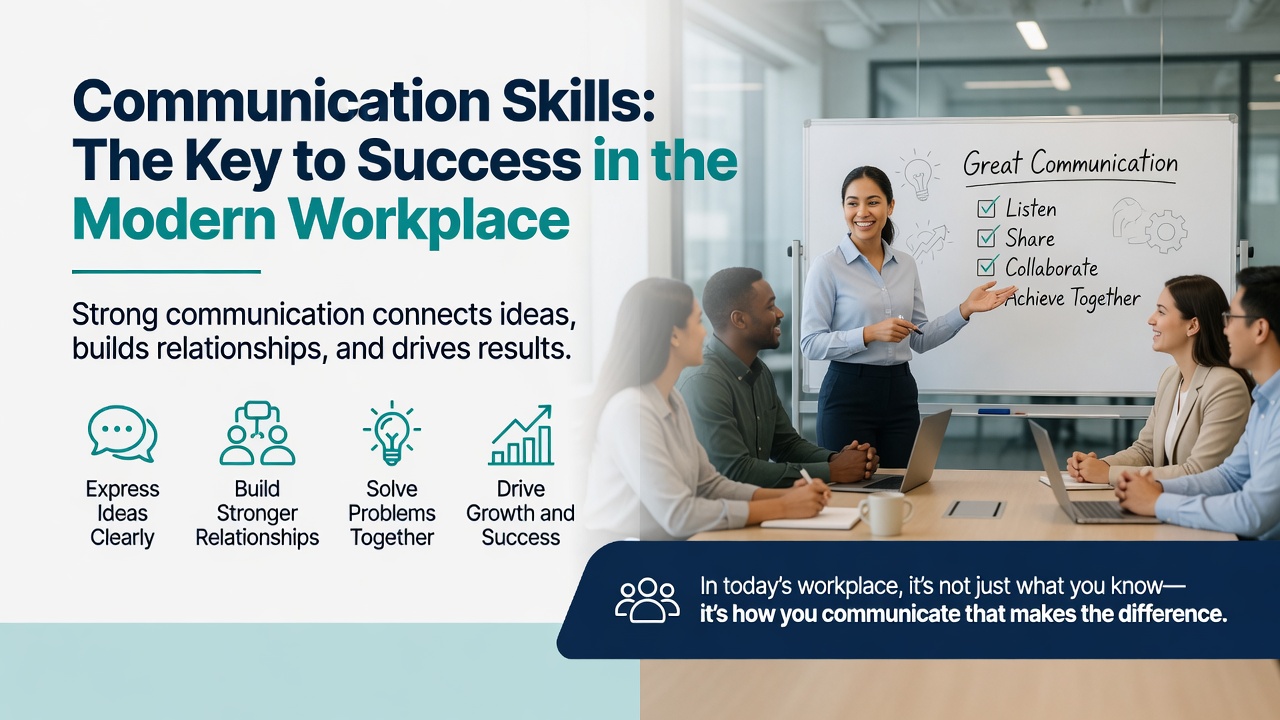
In the rapidly evolving landscape of the modern workplace, technical proficiency (hard skills) is merely the baseline for entry. Whether you are a software engineer, a marketing executive, or a financial analyst, the ceiling of your career trajectory is ultimately dictated by your communication skills. The ability to articulate complex ideas, navigate interpersonal friction, and inspire collective action is the definitive currency of professional success.
The modern workplace is no longer defined by physical cubicles and hierarchical silos. It is global, hyper-connected, asynchronous, and hybrid. Today’s professionals must seamlessly transition between pitching a strategy via a high-stakes video conference, drafting precise asynchronous updates on platforms like Slack, and navigating culturally diverse, cross-functional team dynamics.
This comprehensive guide deconstructs the anatomy of effective workplace communication. It explores the psychological underpinnings of active listening, the strategic deployment of digital communication frameworks, conflict resolution paradigms, and the nuanced leadership communication required to thrive in a digital-first economy.
2. The Evolution of Workplace Communication
To master communication today, one must understand how structural shifts in corporate environments have rewritten the rules of engagement.
2.1. The Shift to Asynchronous Communication
Historically, workplace communication was synchronous—it happened in real-time via meetings, phone calls, or desk drop-ins. Today, distributed teams spanning multiple time zones rely heavily on asynchronous (async) communication. Async communication allows individuals to consume information and respond on their own schedule (e.g., via specialized project management boards, detailed documentation, or recorded video messages). Mastery of async communication requires deep clarity, as the sender is not present to answer immediate clarifying questions.
2.2. The Hybrid Paradigm
The hybrid work model creates a unique communication challenge: the disparity of presence. When half a team is in a physical conference room and the other half is on a screen, information asymmetry naturally occurs. “Watercooler” conversations—organic, impromptu exchanges of information—are lost for remote workers. Modern communicators must consciously design inclusive communication loops, ensuring that remote stakeholders are intentionally integrated into decision-making processes.
3. The Four Pillars of Effective Communication
Exceptional communicators do not rely on natural charisma; they rely on a structural mastery of four distinct pillars.
3.1. Verbal Communication: Clarity and Conciseness
Verbal communication in a corporate setting is not about speaking the most; it is about delivering the highest ratio of signal to noise.
- The BLUF Framework (Bottom Line Up Front): Military and executive communication rely on BLUF. Instead of building up to a conclusion over five minutes, state the primary takeaway, decision, or request in the first ten seconds, then provide the supporting context.
- Audience Calibration: A technical update delivered to a fellow engineer should sound completely different from a technical update delivered to the Chief Marketing Officer. Tailor the vocabulary, depth, and focal point to the listener’s specific priorities.
3.2. Non-Verbal Communication: The Silent Authority
Research consistently shows that a massive percentage of human communication is non-verbal. In the workplace, this translates to body language, eye contact, and vocal tonality.
- Digital Non-Verbals: In a Zoom era, non-verbal cues adapt. It means looking directly into the camera lens (not the screen) to simulate eye contact, keeping hands visible to build trust, and utilizing proper lighting to ensure facial expressions are readable.
- Posture and Presence: Physical posture signals confidence and receptivity. “Closed” body language (crossed arms, slumping) subconsciously signals defensiveness or disinterest to colleagues.
3.3. Written Communication: Precision and Tone
In a digital-first environment, your writing *is* your professional identity. Written communication must be scannable, definitive, and stripped of ambiguity.
2. Formatting: Use bullet points, bolded keywords, and short paragraphs. No one reads a dense wall of text.
3. The Call to Action (CTA): Never end an email without explicitly stating who needs to do what, and by when.
3.4. Active Listening: The Rarest Skill
Most professionals do not listen to understand; they listen to reply. Active listening is a disciplined, cognitive process of fully concentrating, understanding, responding, and remembering what is being said.
- Tactical Empathy: Acknowledging the emotional state of the speaker before addressing the logical problem. (e.g., “It sounds like you’re incredibly frustrated by the shifting deadlines on this project.”)
- Reflective Listening: Summarizing what the other person said and repeating it back to them to confirm understanding and demonstrate respect.
4. Navigating the Digital Ecosystem (Slack, Teams, and Video)
The medium dictates the message. Using the wrong platform for a specific type of communication creates organizational drag and interpersonal friction.
| Communication Channel | Optimal Use Case | Common Pitfalls to Avoid |
|---|---|---|
| Instant Messaging (Slack / Teams) | Quick questions, daily status updates, informal team bonding, sharing immediate links. | Having complex debates, delivering negative feedback, expecting immediate replies outside of core hours. |
| External communication, formal approvals, highly detailed documentation, asynchronous requests. | Urgent time-sensitive requests, lengthy back-and-forth “reply all” chains that should be a meeting. | |
| Video Conference (Zoom) | Brainstorming, complex problem-solving, performance reviews, nuanced relationship building. | “Status update” meetings where participants just read from a list (these should be emails or async documents). |
5. The Psychology of Conflict Resolution and Feedback
The true test of communication skills occurs under pressure. Avoiding conflict leads to organizational decay; navigating it skillfully leads to innovation and trust.
5.1. The SBI Model for Feedback
Delivering critical feedback is a minefield of potential defensiveness. The Situation-Behavior-Impact (SBI) model removes personal attacks and anchors the conversation in objective reality:
- Situation: Define the exact time and place. “During yesterday’s client presentation…”
- Behavior: Describe the observable action without assigning intent. “…you interrupted the client three times while they were explaining their constraints.”
- Impact: Explain the result of the behavior. “…this caused the client to shut down and we lost the opportunity to understand their full budget.”
5.2. Managing Up
Communicating effectively with your manager or executives requires a specific skill set known as “managing up.” It involves understanding their communication preferences, anticipating their questions, and bringing solutions rather than just problems. When presenting an issue to a superior, the golden rule is the “1-3-1 Framework”: Define 1 specific problem, offer 3 viable solutions, and make 1 clear recommendation.
6. Advanced Strategies for Leadership Communication
As professionals transition into leadership, communication shifts from executing tasks to aligning human capital toward a shared vision.
Strategic Repetition
Leaders often suffer from the “illusion of transparency”—believing that because they said something once in a town hall, the entire organization absorbed it. Effective organizational communication requires strategic repetition. A core message must be delivered across multiple channels (email, video, 1-on-1s, Slack) at least seven times before it truly penetrates the organizational consciousness.
Psychological Safety
The most innovative teams are built on a foundation of psychological safety—a shared belief that the team is safe for interpersonal risk-taking. Leaders communicate this by actively soliciting dissenting opinions, admitting their own mistakes openly (“I got this wrong, here is what I learned”), and strictly separating the evaluation of an *idea* from the evaluation of the *person* who proposed it.
7. Conclusion: The Competitive Moat
Artificial Intelligence will inevitably automate routine code generation, data analysis, and standard copywriting. However, AI cannot read the nuanced tension in a boardroom, empathetically de-escalate a frustrated client, or rally a burned-out team behind a difficult project.
Exceptional communication skills are the ultimate competitive moat for human professionals. By committing to the rigorous development of active listening, structural clarity, and emotional intelligence, you do not just make yourself a better employee—you position yourself as an indispensable leader in the future of work.
Frequently Asked Questions (FAQ)