Introduction
For the first half-century of the digital age, the fundamental premise of corporate technology was intrinsically tied to physical machinery. If an organization wanted to launch a new software application, scale its user base, or store massive amounts of corporate data, it had no choice but to physically procure, power, cool, and maintain discrete silicon hardware within its own walls. This operational reality was defined by massive capital expenditures, agonizingly slow procurement lifecycles, and a profound systemic inefficiency: expensive infrastructure often sat completely idle during off-peak hours, yet buckled catastrophically under unexpected surges in traffic. The technological landscape was rigid, fragmented, and fundamentally constrained by the limitations of bare metal.
Meaning and Concept of Cloud Computing
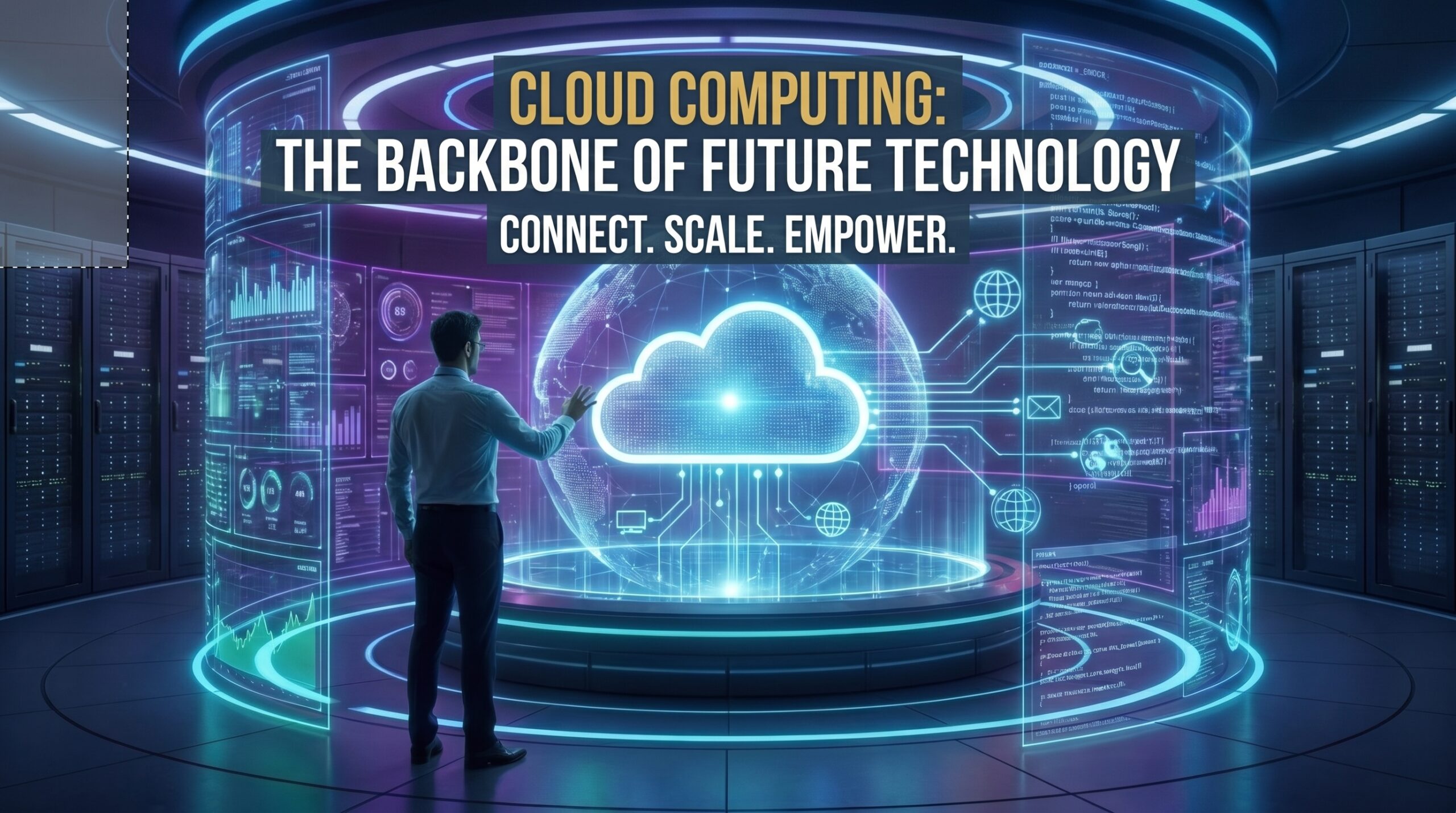
At its core, Cloud Computing is the delivery of on-demand computing services—from applications to storage and processing power—typically over the internet and on a pay-as-you-go basis. Rather than owning their own computing infrastructure or data centers, companies can rent access to anything from applications to storage from a cloud service provider. The fundamental concept relies on the absolute separation of logical computing resources from physical hardware. When a software engineer “spins up a server” in the cloud, they are not interacting with a physical metal box; they are interacting with a highly sophisticated software abstraction that mathematically simulates a computer, carving out processing power from a massive, globally distributed pool of underlying physical servers.
This abstraction layer allows for an unprecedented level of agility. A startup in a garage can instantly access the exact same military-grade infrastructure, global fiber-optic networks, and massive parallel processing clusters as a Fortune 500 enterprise. Cloud Computing democratizes scale. It removes the friction of hardware management, allowing engineering teams to focus entirely on writing business logic and deploying innovative code, while the cloud provider assumes the entire burden of keeping the data center online, cooled, patched, and physically secure.
History and Evolution of Cloud Computing
The realization of Cloud Computing was not an overnight breakthrough, but rather the culmination of a multi-decade evolutionary arc across the fields of distributed systems and network architecture. The conceptual foundation was laid as early as the 1960s by computer scientist John McCarthy, who famously posited that “computation may someday be organized as a public utility.” During this era, the concept of “time-sharing” on massive, multi-million-dollar IBM mainframes allowed multiple users to share a single physical CPU via primitive “dumb terminals,” establishing the earliest baseline for multi-tenant resource optimization.
By the 1990s, the concept evolved into Grid Computing, which sought to solve hyper-complex scientific and mathematical problems by linking geographically dispersed computing nodes into a single cohesive cluster. While grid computing successfully pooled immense computational power, it lacked elasticity and required specialized software to execute across distributed environments. This was closely followed by Application Service Providers (ASPs) in the late 1990s, which attempted to host and deliver software applications to consumers over the early internet. However, their efforts were ultimately bottlenecked by the primitive dial-up and nascent broadband infrastructures of the time.
The true inflection point arrived in the mid-2000s, driven by massive internal optimization efforts within global e-commerce. Amazon realized that its massive internal data center infrastructure operated at a fraction of its true capacity for the majority of the year, over-provisioned solely to survive the extreme traffic anomalies of the holiday shopping season. By leveraging advances in x86 hardware virtualization, Amazon engineers realized they could abstract this excess physical capacity into isolated “virtual machines” and rent them out over the internet as an on-demand service. The launch of Amazon Elastic Compute Cloud (EC2) and Simple Storage Service (S3) in 2006 marked the birth of the modern commercial cloud era. Soon after, tech giants like Google and Microsoft entered the arena, sparking a hyperscale arms race that resulted in the massive global data center networks that power the internet today.
Difference Between Traditional On-Premises and Cloud Infrastructure
To fully grasp the magnitude of the cloud revolution, one must contrast it with the traditional “on-premises” IT model that dominated the late 20th century. The differences span financial models, operational agility, and scalability.
- CapEx vs. OpEx Financial Models: Traditional IT relies heavily on Capital Expenditure (CapEx). Companies must invest massive upfront capital to purchase servers, networking gear, and software licenses, which then depreciate over a 3-to-5-year hardware cycle. Cloud computing shifts this entirely to Operating Expenditure (OpEx). There are zero upfront costs; organizations pay a monthly, metered bill based strictly on the exact gigabytes of storage or milliseconds of compute time they consumed.
- Scalability vs. Elasticity: Traditional hardware is statically scalable. If a company needs more power, it must purchase and rack a new physical server—a process taking weeks or months. Furthermore, once bought, that capacity cannot be easily downscaled. Cloud computing provides Rapid Elasticity. An application can automatically scale from utilizing one server to one thousand servers in a matter of seconds in response to a sudden viral traffic spike, and just as rapidly terminate those 999 extra servers when the traffic subsides, stopping the billing meter instantly.
- Maintenance and Operational Burden: In an on-premises data center, the internal IT team is responsible for everything: hardware replacement, localized power grid backups, physical security, cooling systems, and hypervisor patching. In the cloud, this “undifferentiated heavy lifting” is entirely offloaded to the cloud provider, freeing the corporate IT staff to focus on strategic software development and business outcomes rather than swapping out failed hard drives at 3:00 AM.
“Cloud computing is often far more secure than traditional computing, because companies like Google and Amazon can attract and retain cyber-security personnel of a higher quality than many governmental agencies.” – Bruce Schneier, Cryptographer and Security Professional
Why Cloud Computing Is the Technology Powering Tomorrow’s World
The assertion that Cloud Computing is the structural backbone of the future is an empirical reality. As we transition into the Fourth Industrial Revolution, the technologies that will define the next century are completely dependent on the foundational compute power provided by the cloud.
Consider the explosion of Artificial Intelligence and Large Language Models (LLMs). Training an AI model like ChatGPT requires processing terabytes of text data through thousands of highly specialized Graphics Processing Units (GPUs) running continuously for months. The cost to construct an on-premises data center capable of this would be hundreds of millions of dollars, effectively locking out all but a handful of global corporations from AI research. Cloud computing providers democratize this process by allowing researchers to rent clusters of the world’s most powerful AI supercomputers by the hour, conduct their training, and then release the hardware. Without the cloud, the current global renaissance in Artificial Intelligence simply would not exist.
Furthermore, Cloud Computing applications are the prerequisite for global connectivity paradigms like the Internet of Things (IoT) and autonomous vehicles. A fleet of self-driving cars navigating a smart city generates petabytes of telemetry data every single day. This data must be ingested, processed, and analyzed in near real-time. Only the globally distributed, edge-enabled networks of public cloud providers possess the bandwidth and processing elasticity required to handle these astronomical data streams without catastrophic latency.
Benefits of Cloud Computing
- Global Reach in Minutes: An application developed in a local coffee shop can be deployed instantly to cloud data centers in Tokyo, Frankfurt, and Sydney, providing low-latency experiences to users worldwide.
- Unmatched Disaster Recovery: Cloud platforms allow for data to be synchronously replicated across multiple geographic regions, ensuring that even if an entire continent experiences a power grid failure, corporate data remains safe and accessible.
- Continuous Innovation: Cloud providers release hundreds of new services annually—from quantum computing simulators to managed satellite ground stations—giving developers instant access to cutting-edge tools without requiring any local installation or configuration.
- Environmental Sustainability: Hyperscale cloud data centers are significantly more energy-efficient than traditional corporate server rooms. By pooling resources and utilizing advanced AI for cooling, cloud providers vastly reduce the carbon footprint per unit of compute power, with many committing to 100% renewable energy operations.
How Cloud Computing Works: The Engine of Virtualization
The invisible engine that powers Cloud Computing technology is a process known as Virtualization. Virtualization is the sophisticated software technology that breaks the rigid dependency between a computer’s operating system and its underlying physical hardware. In a traditional setup, a physical server runs a single operating system (like Windows or Linux). If that server’s hardware is powerful, but the application running on it only requires a fraction of that power, the rest of the CPU and RAM sits idle and wasted.
Cloud providers solve this by installing a specialized, deeply optimized layer of software called a Hypervisor directly onto the bare metal of their physical servers. The hypervisor intercepts the low-level system calls made by operating systems and mathematical partitions the single physical server into multiple, completely isolated “Virtual Machines” (VMs). Each VM acts exactly like a real, physical computer. It possesses its own virtual CPU, virtual RAM, virtual hard drive, and its own completely independent guest Operating System.
Through this technology, a cloud provider can take a single, massive physical server and run fifty different virtual machines on it simultaneously. One VM might belong to a healthcare company running a database, another might belong to a retail startup running a web server, and a third might belong to a student learning how to code. Because the hypervisor enforces strict logical isolation, none of the virtual machines can see, access, or interfere with the data of the others, ensuring absolute security and privacy in a shared, multi-tenant environment.
Core Characteristics of Cloud Computing
To differentiate true cloud infrastructure from standard, legacy internet hosting, the National Institute of Standards and Technology (NIST) established a strict definitional framework. For an environment to be officially classified as a cloud, it must exhibit five essential characteristics.
- On-Demand Self-Service: A consumer can unilaterally provision computing capabilities, such as server time and network storage, automatically via an online control panel or an API, without requiring any human interaction with the service provider’s staff.
- Broad Network Access: Capabilities are available over the network and accessed through standard mechanisms that promote use by heterogeneous thin or thick client platforms (e.g., mobile phones, tablets, laptops, and automated microservices).
- Resource Pooling (Multi-Tenancy): The provider’s computing resources are pooled to serve multiple consumers using a multi-tenant model, with different physical and virtual resources dynamically assigned and reassigned according to consumer demand. The customer generally has no control or knowledge over the exact physical location of the provided resources (e.g., they do not know which specific rack or hard drive their data is on).
- Rapid Elasticity: Capabilities can be elastically provisioned and released—often automatically via auto-scaling rules—to scale rapidly outward and inward commensurate with demand. To the consumer, the capabilities available for provisioning often appear to be infinite.
- Measured Service: Cloud systems automatically control and optimize resource use by leveraging a metering capability at some level of abstraction appropriate to the type of service (e.g., storage, processing, bandwidth, and active user accounts). Resource usage is constantly monitored, controlled, and reported, providing transparency for both the provider and the consumer of the utilized service.
Types of Cloud Service Models (XaaS)
The structural distribution of management responsibility between the cloud consumer and the cloud provider is formally organized into discrete service delivery models. Often visualized as a stack, each progressive layer abstracts away deeper levels of IT complexity, allowing organizations to choose the precise level of granular control their operational workloads require. This is broadly referred to as “Anything as a Service” (XaaS).
Infrastructure as a Service (IaaS)
IaaS represents the foundational, lowest-level brick of the cloud service ecosystem. In an IaaS model, the cloud provider owns, maintains, and secures the physical data centers, the power grids, the network switches, the physical servers, and the bare-metal virtualization hypervisors. The provider abstracts these physical resources and delivers them to the consumer over the internet as raw virtualized compute instances, raw network interfaces, and unformatted block storage.
The customer retains absolute architectural control over the operating system upward. They must choose their OS (e.g., Ubuntu Linux, Windows Server), perform security patching, configure complex network route tables, manage runtime environments, and write the application code. IaaS provides maximum flexibility, making it the ideal migration destination for complex, legacy enterprise applications that require specific, low-level operating system configurations.
Platform as a Service (PaaS)
PaaS shifts the abstraction boundary significantly higher up the technology stack, completely removing the burden of operating system administration from the customer’s purview. In a PaaS model, the cloud provider assumes full responsibility for provisioning the servers, installing the OS, applying security patches, and maintaining the software execution frameworks (such as Node.js, Python, or Java runtimes).
The consumer is simply provided with a unified, managed platform where they can deploy their proprietary application code without ever worrying about the underlying infrastructure machinery. PaaS drastically accelerates software development lifecycles, allowing engineering teams to focus exclusively on feature development, user experience, and data architecture rather than spending hours configuring web servers.
Software as a Service (SaaS)
SaaS represents the complete and total abstraction of the technology stack. In a SaaS delivery model, the provider delivers a fully functional, complete end-user application over the internet, typically accessed via a web browser or a mobile app. The customer has zero visibility or control over the infrastructure, the operating systems, the network topologies, or even the underlying codebase.
The only responsibility retained by the customer is the configuration of user access permissions and the governance of the data they input into the application. SaaS applications are inherently multi-tenant, serving millions of global users simultaneously from a singular, centralized code branch. Enterprise email clients, Customer Relationship Management (CRM) platforms, and collaborative document editing spaces are classic manifestations of SaaS. It converts complex software from an engineering headache into a simple operational utility.
Function as a Service (FaaS) / Serverless Computing
The newest and most advanced evolution of the cloud service taxonomy is Function as a Service (FaaS), the core technology powering “Serverless Computing.” Despite the name, servers are obviously still involved; rather, it means the abstraction is so total that the consumer never has to reason about server allocation, capacity planning, or idle uptime at all.
In traditional IaaS or PaaS, you provision a server that runs continuously, costing you money whether it is receiving traffic or sitting completely idle at 4:00 AM. In a FaaS model, application logic is broken down into small, discrete, ephemeral code functions that remain completely dormant. When a specific event occurs—such as a user uploading an image to a bucket or an IoT sensor sending a temperature reading—the cloud provider instantly spins up a container in milliseconds, executes the code function, processes the data, and immediately destroys the container. The organization is billed strictly for the execution time of the function measured in sub-millisecond increments, resulting in a true zero-cost environment for completely idle applications.
| IT Component | Traditional On-Premises | IaaS | PaaS | SaaS |
|---|---|---|---|---|
| Applications | You Manage | You Manage | You Manage | Provider Manages |
| Data | You Manage | You Manage | You Manage | Provider Manages |
| Runtime / Middleware | You Manage | You Manage | Provider Manages | Provider Manages |
| Operating System (O/S) | You Manage | You Manage | Provider Manages | Provider Manages |
| Virtualization Layer | You Manage | Provider Manages | Provider Manages | Provider Manages |
| Servers, Storage & Networking | You Manage | Provider Manages | Provider Manages | Provider Manages |
Cloud Deployment Models
Cloud computing is not a monolithic monoculture. The choice of how cloud infrastructure is deployed, and who owns the underlying hardware fabric, depends entirely on an organization’s regulatory environment, security posture, data localization mandates, and legacy capital investments. There are four primary deployment architectures.
Public Cloud
The Public Cloud is the standard, most ubiquitous deployment model. The infrastructure is owned, operated, and maintained by massive hyperscale technology firms (e.g., Amazon Web Services, Microsoft Azure, Google Cloud Platform). The physical hardware fabric is hosted within the provider’s global data center arrays, and resources are dynamically shared among millions of discrete, unrelated organizations over the public internet. Public clouds offer unmatched economies of scale, near-infinite capacity elasticity, and zero capital expenditure entry barriers. It is the default deployment mechanism for modern startups and forward-thinking enterprises.
Private Cloud
A Private Cloud is a cloud infrastructure environment dedicated exclusively to a single organization. It replicates the primary characteristics of the public cloud—such as virtualization, resource pooling, and self-service provisioning—but deliberately strips away the shared multi-tenant aspect. Private clouds can be hosted physically within an enterprise’s own corporate data center (On-Premises Private Cloud) or managed by a third-party provider on dedicated, isolated hardware blocks (Hosted Private Cloud).
Private clouds are heavily utilized by highly regulated industries—such as defense agencies, investment banks, and healthcare networks—where strict data sovereignty laws, national security protocols, or deep legacy mainframes make public multi-tenancy structurally unacceptable. However, private clouds sacrifice the massive economies of scale found in public environments, reintroducing capital expenditure burdens and ongoing physical maintenance overheads.
Hybrid Cloud
The Hybrid Cloud represents an advanced state of architectural maturity, intentionally blending public cloud, private cloud, and on-premises physical legacy infrastructure into a unified, integrated computational ecosystem. A true hybrid cloud requires a high degree of interoperability and data portability, orchestrated by specialized middleware and standardized secure networking fabrics.
Hybrid cloud enables a highly strategic operational design pattern known as “Cloud Bursting.” Under normal operational parameters, an organization runs its steady-state, highly sensitive workloads safely within its private cloud environment. However, if a massive seasonal traffic anomaly occurs (such as Black Friday for a retailer) that threatens to saturate the private data center’s physical limits, the system dynamically bridges outward, spawning temporary compute instances within the public cloud to absorb the excess traffic spike. Once the spike subsides, the public cloud instances are dissolved, keeping primary data securely contained within the private perimeter during baseline operations.
Multi-Cloud
Multi-Cloud refers to the deliberate distribution of an organization’s digital assets, applications, and workloads across multiple independent public cloud service providers simultaneously. Rather than anchoring its entire global digital operations within a single vendor, an enterprise will utilize a combination of AWS, Azure, and Google Cloud.
The primary driver for a multi-cloud strategy is the mitigation of systemic risk and the prevention of “Vendor Lock-in.” If a single cloud provider experiences a catastrophic regional data center fire, or implements a sudden, predatory pricing increase, an organization reliant on a single vendor could be crippled. Multi-cloud provides absolute disaster recovery redundancy. Furthermore, it allows organizations to capitalize on the unique algorithmic specialties of different vendors—for instance, running core enterprise applications with one provider while routing heavy machine learning pipelines through another provider that possesses superior specialized AI processing hardware.
Cloud Storage Architectures
Data in the cloud is not stored on a simple, singular hard drive as it is on a personal computer. Hyperscale data processing requires data to be persisted through vastly different structural architectures depending on the latency requirements, scale, and access patterns of the specific workload. Cloud architects primarily utilize three storage typologies.
Object Storage: The Infinite Flat Namespace
Object storage is a revolutionary architecture that completely discards the legacy, hierarchical folder-tree directory model. Instead, data is abstracted into discrete, self-contained units called “objects” and stored within a massive, completely flat namespace. Each object consists of three fundamental components: the raw data payload itself, a unique globally accessible identification string, and an extensible, highly customizable metadata layer that describes the data.
Because there is no complex folder hierarchy for the system to traverse, object storage is structurally unconstrained by scale; it can grow infinitely to house exabytes of unstructured data. It is the storage engine used for high-definition video streaming platforms, raw medical imaging files, automated backup logs, and massive machine learning training corpuses. Data is accessed securely over the internet via standard HTTP API commands. However, because object storage architectures are designed for massive throughput over a flat topology, they possess a higher latency profile, making them unsuitable for running active databases.
Block Storage: Low-Latency Virtual Disks
Block storage acts as a raw, unformatted virtual hard drive mounted directly to a specific cloud compute instance over a high-speed, dedicated Storage Area Network (SAN). In this model, data is broken down into fixed-size chunks or “blocks,” each assigned an explicit sector address on the physical drive, but devoid of any metadata description. The guest operating system mounts this raw block volume, formats it with a native file system (such as ext4 for Linux or NTFS for Windows), and interacts with it directly at the kernel level.
Block storage offers exceptionally low latency and incredibly high Input/Output Operations Per Second (IOPS). It is the non-negotiable storage tier required for hosting relational databases, enterprise resource planning (ERP) platforms, or any transactional engine that mandates instantaneous, microsecond read/write speeds.
File Storage: Hierarchical Network Shares
File storage brings the traditional, familiar hierarchical folder-tree model into the scalable network space. It allows multiple independent compute instances to mount a singular shared drive simultaneously over the network using standardized communication protocols such as Network File System (NFS) or Server Message Block (SMB).
File storage is specifically engineered for legacy enterprise application migrations that depend explicitly on a structured file path architecture to read and write shared organizational assets. It is heavily utilized in central media editing workflows, high-performance computing (HPC) clusters, and collaborative content management systems.
Cloud Networking and Infrastructure Fabrics
The vast computational scale of the cloud is fundamentally limited without a highly resilient, low-latency communication layer to connect its components. Cloud networking abstracts complex, physical hardware topologies (like routers and switches) into programmatic, Software-Defined Networks (SDN) capable of routing data packets globally in milliseconds.
Virtual Private Clouds (VPCs) and Subnet Architecture
A Virtual Private Cloud (VPC) is a logically isolated, private network environment carved out explicitly for a single customer within the massive, shared public cloud fabric. It provides complete network sovereignty. Within a VPC, the cloud engineer possesses total control over the allocation of IP address spaces, the definition of network routing tables, and the creation of isolated network subnets.
A resilient cloud network design divides a VPC into distinct functional zones. Public Subnets are explicitly connected to an Internet Gateway. Compute instances placed within this layer are assigned public IP addresses and are directly reachable from the outside world. This is where edge, public-facing infrastructure like web servers must reside. Conversely, Private Subnets possess no direct route to the outside internet. Instances housed within this zone are assigned strictly private IP addresses. This is where critical business logic—such as database backends, payment processing engines, and proprietary microservices—must live to prevent direct external cyberattacks.
Load Balancing and Edge Delivery
Load balancers are the primary traffic conductors of cloud architecture, critical for achieving high availability. They sit in front of compute instance clusters, continuously assessing the health of each virtual machine, and dynamically distributing incoming internet traffic streams evenly across the healthy nodes to prevent any single machine from bottlenecking or crashing under load.
Furthermore, global applications utilize Content Delivery Networks (CDNs). A CDN is a massive, geographically distributed network of proxy servers situated at the extreme “edge” of the cloud network (often in cities worldwide, far away from the primary data center). CDNs cache static assets—such as images, CSS files, and videos—locally near the user. If a user in London accesses a website hosted in a cloud data center in New York, the CDN will serve the images directly from a server in London, slashing latency to near-zero and drastically improving the user experience.
Skills Required and Future Cloud Computing Careers
- Cloud Solutions Architect: Responsible for designing highly available, fault-tolerant, and cost-optimized cloud environments. They translate business requirements into complex technical blueprints.
- Cloud Security Engineer: Focuses on Identity and Access Management (IAM), data encryption, threat detection, and ensuring strict compliance with global data privacy frameworks within the cloud perimeter.
- DevOps / Site Reliability Engineer (SRE): Bridges the gap between software development and IT operations. They utilize Infrastructure as Code (IaC) tools like Terraform to automate cloud deployments and build continuous integration/continuous delivery (CI/CD) pipelines.
- FinOps Practitioner: An emerging role that blends finance and cloud engineering. They continuously analyze cloud consumption metrics to eliminate resource waste, right-size instances, and govern the organization’s variable cloud spend.