Introduction
The Digital Imperative
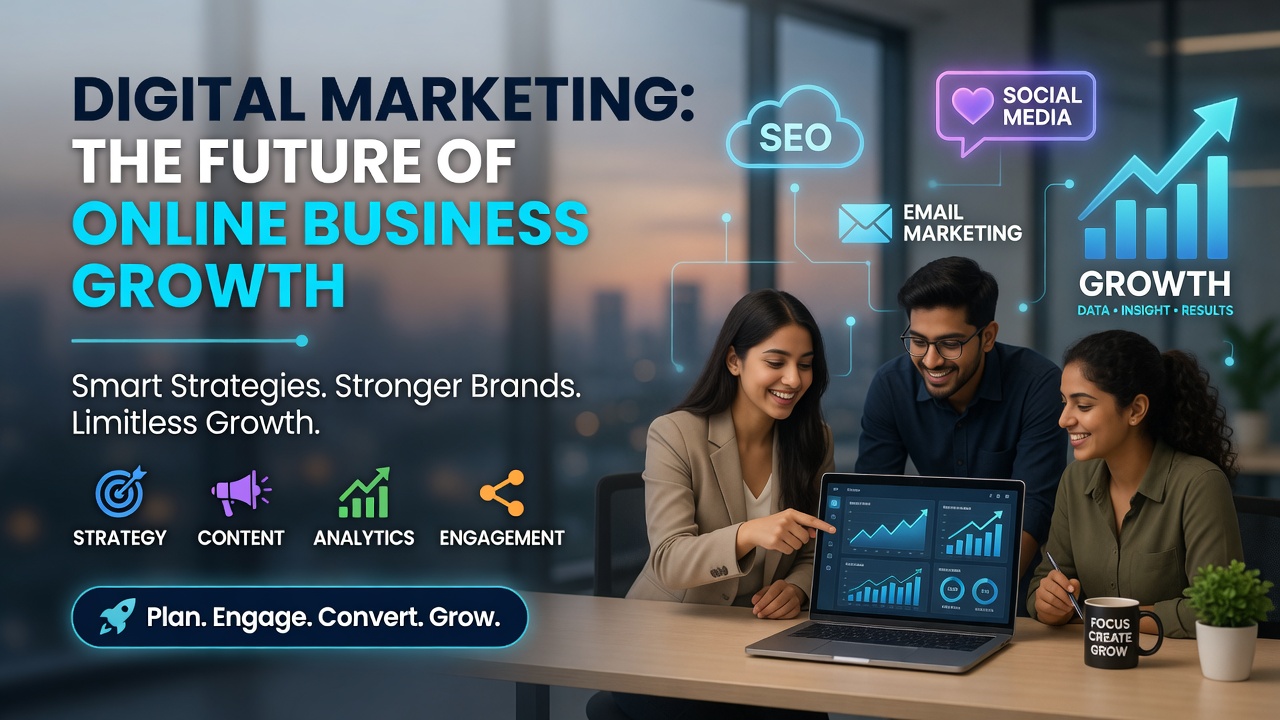
The days of relying solely on billboards, print advertisements, and television commercials are over. We have firmly entered an era where human attention is predominantly digital. Digital marketing is no longer just a subset of a broader marketing strategy; for modern businesses, it is the strategy. It encompasses all marketing efforts that use an electronic device or the internet, leveraging search engines, social media, email, and websites to connect with current and prospective customers.
Unlike traditional marketing, which relies on a “spray and pray” approach (broadcasting a message to a massive audience and hoping it resonates with a few), digital marketing is highly surgical. It allows brands to target hyper-specific demographics, track every single interaction in real-time, measure exact return on investment (ROI), and dynamically adjust campaigns based on consumer behavior.
This comprehensive guide explores the evolution of this dynamic field, deeply dissects its core pillars, examines the critical role of data and attribution, and looks forward to the profound impact of Artificial Intelligence, privacy regulations, and shifting consumer psychology on the future of online business growth.
2. The Evolution: From Web 1.0 to Web 3.0
To understand where digital marketing is going, it is crucial to understand how it evolved alongside the internet itself.
The Web 1.0 Era: The Static Web (1990s – Early 2000s)
In the early days of the internet, websites were essentially digital brochures. They were static, read-only pages. Marketing during this era was rudimentary. The first clickable banner ad debuted in 1994 (for AT&T, boasting a massive 44% click-through rate). Marketers focused heavily on email blasts and early, highly manipulatable search engine optimization (SEO), often resorting to keyword stuffing to rank on nascent search engines like Yahoo and AltaVista.
The Web 2.0 Era: The Social Web (Mid 2000s – 2020)
The launch of broadband, smartphones, and platforms like Facebook, YouTube, and Twitter fundamentally altered the landscape. The internet became interactive, user-generated, and deeply social. Marketing shifted from a one-way broadcast to a two-way conversation. Brands had to cultivate communities, engage with user-generated content, and manage their online reputations. This era also saw the absolute dominance of Google Ads and Facebook Ads, turning digital marketing into a highly sophisticated, data-driven auction system.
The Web 3.0 Era: The Semantic and AI Web (2020s – Present)
We are currently navigating the transition into Web 3.0. This era is defined by Artificial Intelligence, machine learning, decentralized networks, and hyper-personalization. Search engines now understand user intent rather than just keywords. Generative AI allows for the instant creation of copy and imagery. Furthermore, rising privacy concerns (like the death of third-party cookies) are forcing marketers to rethink how they collect data and track users, leading to a massive focus on first-party data and brand loyalty.
3. The Core Pillars of Digital Marketing
A successful digital marketing strategy rarely relies on a single channel. Instead, it requires an omnichannel approach, integrating multiple pillars to guide a consumer smoothly through the buying funnel—from initial awareness to final conversion and advocacy.
3.1. Search Engine Optimization (SEO)
SEO is the art and science of optimizing a website to rank higher in organic (non-paid) search engine results pages (SERPs), primarily on Google. It is a long-term play, but it yields the highest ROI of any digital channel because it captures high-intent traffic.
- On-Page SEO: Optimizing the content and HTML source code of a page. This includes keyword research, crafting compelling title tags and meta descriptions, optimizing header tags (H1, H2), and ensuring the content satisfies the user’s search intent.
- Off-Page SEO: Actions taken outside of your own website to impact your rankings. The primary focus here is backlink building—acquiring links from other high-authority, relevant websites, which act as “votes of confidence” in the eyes of Google.
- Technical SEO: Ensuring that search engine spiders can efficiently crawl and index your site. This involves optimizing site speed, ensuring mobile-friendliness (mobile-first indexing), implementing structured data (schema markup), and creating a logical site architecture.
- E-E-A-T: Google heavily weighs Experience, Expertise, Authoritativeness, and Trustworthiness. Content must be factually accurate, written by credible authors, and hosted on secure, reputable domains.
3.2. Content Marketing
If SEO is the mechanism that drives traffic, content is the destination. Content marketing focuses on creating and distributing valuable, relevant, and consistent content to attract and retain a clearly defined audience.
Middle of Funnel (MOFU): Focuses on evaluation. The user knows their problem and is looking for solutions (e.g., e-books, webinars, case studies, comparison guides).
Bottom of Funnel (BOFU): Focuses on conversion. The user is ready to buy (e.g., free trials, live demos, highly targeted email sequences, product landing pages).
3.3. Pay-Per-Click Advertising (PPC) & Search Engine Marketing (SEM)
PPC is a model of internet marketing in which advertisers pay a fee each time one of their ads is clicked. It is essentially buying visits to your site, rather than attempting to “earn” those visits organically.
- Search Ads (Google Ads): The most common form of PPC. Advertisers bid on specific keywords. When a user searches for that keyword, the ad appears at the top of the SERP. Success depends on Bid Amount and Quality Score (a metric measuring the relevance of your ad and landing page).
- Display Ads: Visual banner ads that appear on third-party websites across the internet (e.g., the Google Display Network). These are generally used for brand awareness and retargeting.
- Retargeting/Remarketing: Serving ads specifically to users who have previously visited your website but did not convert. Because the user is already familiar with the brand, retargeting campaigns typically boast incredibly high conversion rates.
3.4. Social Media Marketing (SMM)
SMM involves creating tailored content for specific social media platforms to drive engagement, build brand awareness, and generate sales.
- Organic Social: Building a community through unpaid posts. This requires a deep understanding of platform-specific algorithms. For example, TikTok prioritizes raw, authentic, short-form video, while LinkedIn prioritizes professional thought leadership and text-heavy industry insights.
- Paid Social: Platforms like Meta (Facebook/Instagram), LinkedIn, and X (Twitter) offer highly granular advertising dashboards. Advertisers can target users based on profound psychographic data—interests, job titles, life events (e.g., recently engaged), and behaviors.
- Influencer Marketing: Partnering with individuals who have a dedicated social following. Modern trends lean toward micro-influencers (10k – 50k followers) who often boast much higher engagement rates and niche trust than massive celebrities.
3.5. Email Marketing
Despite being one of the oldest digital channels, email marketing consistently delivers the highest ROI. It is the only channel where the brand actually owns the audience, free from the volatile algorithmic changes of Google or Meta.
- Segmentation and Personalization: Blasting the same email to a massive list is obsolete. Modern email marketing relies on segmenting audiences based on behavior (e.g., users who abandoned their cart, VIP purchasers, dormant subscribers) and sending hyper-personalized, triggered workflows.
- Automation Workflows: Setting up “drip campaigns” that automatically nurture leads over time. For example, a welcome series for new subscribers that introduces the brand story over five days before pitching a product.
4. The Backbone of Growth: Data, Analytics, and Attribution
The defining advantage of digital marketing is trackability. However, drowning in data without extracting actionable insights is a common pitfall. Mastering analytics is what separates amateur campaigns from scalable business growth.
Key Performance Indicators (KPIs)
Marketers must track metrics that directly align with business objectives, avoiding “vanity metrics” (like raw follower counts or mere pageviews) in favor of actionable data.
| Metric | Definition | Significance |
|---|---|---|
| Customer Acquisition Cost (CAC) | Total marketing spend divided by the number of new customers acquired. | Determines if the marketing engine is financially sustainable. |
| Customer Lifetime Value (CLV / LTV) | The total revenue a business can reasonably expect from a single customer account. | Crucial for understanding how much you can afford to spend on CAC (The LTV:CAC ratio). |
| Return on Ad Spend (ROAS) | Revenue generated for every dollar spent on an advertising campaign. | Measures the direct, immediate profitability of a specific ad channel. |
| Conversion Rate (CR) | The percentage of visitors who complete a desired action (purchase, form fill). | Highlights the effectiveness of your landing pages and user experience (UX). |
The Attribution Dilemma
Attribution is the process of assigning credit for a sale to specific touchpoints in a customer’s journey. A customer might see a Facebook ad on Monday, click a Google Search ad on Wednesday, and finally convert via an Email newsletter on Friday. Who gets the credit?
- Last-Click Attribution: Gives 100% of the credit to the final touchpoint (the email). This is historically common but deeply flawed, as it ignores the awareness built by Facebook and Google.
- Linear Attribution: Distributes credit equally among all touchpoints.
- Data-Driven / Algorithmic Attribution: The modern gold standard. Uses machine learning to calculate the actual fractional impact of every single touchpoint on the final conversion, adjusting credit dynamically.
5. Advanced Strategies and Emerging Technologies
The digital marketing landscape evolves at breakneck speed. To maintain a competitive edge, businesses must adapt to emerging technologies and shifting consumer paradigms.
5.1. Artificial Intelligence and Machine Learning
AI is completely rewiring the digital marketing industry. It is no longer a futuristic concept; it is an active, daily utility.
- Generative AI: Tools like ChatGPT, Jasper, and Midjourney are revolutionizing content creation. Marketers use AI to draft ad copy, brainstorm blog outlines, generate variations of landing pages, and create high-fidelity advertising imagery in seconds.
- Predictive Analytics: AI algorithms analyze vast amounts of historical consumer data to predict future behavior. It can forecast inventory needs, predict which customers are most likely to churn (cancel a subscription), and identify which leads have the highest probability of closing.
- Programmatic Advertising: The automated buying and selling of online advertising space in real-time. Algorithms bid on ad impressions in milliseconds while a webpage is loading, showing hyper-targeted ads to specific users based on their browsing history and demographic profile.
5.2. The Optimization of Voice and Visual Search
The way consumers search for information is changing. With the proliferation of smart speakers (Alexa, Google Home), Voice Search Optimization is critical. Voice queries are longer, conversational, and often framed as questions (e.g., “Where is the best Italian restaurant near me?”). SEO strategies must adapt to target long-tail, conversational keywords and secure “Featured Snippets” (Position Zero) on Google.
Similarly, Visual Search (using tools like Google Lens or Pinterest Lens) allows users to search by taking a photo. E-commerce brands must ensure their image metadata, alt-text, and schemas are flawlessly optimized so their products appear when a user snaps a picture of a similar item in the real world.
5.3. Omnichannel Marketing and The “Phygital” Experience
Consumers do not view channels in silos; they expect a seamless experience whether they are interacting with a brand on Instagram, via email, on a website, or in a physical brick-and-mortar store. Omnichannel marketing ensures consistent messaging and data synchronization across all touchpoints.
Furthermore, Augmented Reality (AR) is creating a “phygital” (physical + digital) experience. Brands like Sephora and IKEA allow users to virtually “try on” makeup or visualize furniture in their living rooms via their smartphone cameras, bridging the gap between digital browsing and physical confidence in a purchase.
6. The Psychology of Digital Consumer Behavior
At its core, digital marketing is simply applied psychology at scale. Understanding how the digital environment alters human decision-making is essential.
Cognitive Biases in Digital Marketing
- Social Proof: Humans look to others to determine correct behavior. Displaying real-time purchase notifications, showcasing thousands of 5-star reviews, and utilizing user-generated content (UGC) significantly increases conversion rates.
- Scarcity and FOMO: The Fear of Missing Out is highly exploitable online. Countdown timers on sales, “Only 2 items left in stock” warnings, and limited-edition digital drops trigger a psychological urgency to buy immediately.
- The Zero Moment of Truth (ZMOT): The moment a consumer grabs their smartphone to research a product they just heard about. Brands must ensure they own the search results for their brand name and relevant product queries to control this critical psychological juncture.
7. Challenges, Ethics, and the Privacy Era
The golden age of unrestricted data collection is over. Digital marketing is currently facing its most significant structural challenges regarding consumer privacy and data ethics.
The Death of the Third-Party Cookie
For years, marketers relied on third-party cookies (code placed on a user’s browser by a website other than the one they are currently visiting) to track users across the internet and serve them retargeted ads. Browsers like Safari and Firefox have already blocked them, and Google Chrome is phasing them out. This “cookie apocalypse” is forcing marketers to pivot heavily toward Zero-Party Data (data a customer intentionally shares, like a survey) and First-Party Data (data a brand collects directly on its own website or CRM).
Privacy Legislation (GDPR and CCPA)
Governments are aggressively regulating how digital data is handled. The General Data Protection Regulation (GDPR) in Europe and the California Consumer Privacy Act (CCPA) mandate that businesses must obtain explicit consent to track users, allow users to easily opt-out of data collection, and provide users with the right to have their data deleted. Non-compliance results in catastrophic financial penalties. Marketers must now balance personalization with strict, ethical privacy protocols.
Ad Fatigue and Algorithmic Volatility
Consumers are bombarded with up to 10,000 digital ads per day. This saturation leads to “banner blindness” and extreme ad fatigue. To break through the noise, brands can no longer rely on mediocre, generic creative. Furthermore, marketers are constantly at the mercy of platform algorithms. A sudden update to Google’s search algorithm or a shift in the TikTok feed can wipe out 50% of a business’s traffic overnight, highlighting the danger of building a business entirely on “rented land” (third-party platforms) rather than owned channels (email, SMS, proprietary websites).
8. Conclusion
Digital marketing is a landscape of perpetual motion. What worked brilliantly five years ago is likely obsolete today, and the strategies of tomorrow are currently being forged by advancements in artificial intelligence and shifting cultural norms.
However, while the tactics, platforms, and algorithms will inevitably change, the fundamental objective remains constant: delivering the right message, to the right person, at the exact right time. The future of online business growth belongs to those who can master the technical complexities of data analytics, respect the boundaries of consumer privacy, and utilize emerging technologies not to replace the human element, but to amplify human creativity and empathy at an unprecedented scale.
Frequently Asked Questions (FAQ)